Let’s travel back two decades, so this story makes sense.
Once again, I found myself near the top of the corporate ladder. Over time, my responsibilities grew until I was expected to address large audiences regularly. Back then — though the term has since been rebranded — our global company employed elocutionists. Today you’d call them coaches. Life coaches, performance coaches, confidence coaches.
Their task was simple: turn competent speakers into orators. Demosthenes, ideally.
Today, public speaking often amounts to “go in there and do your thing,” while half the audience stares at their phones, the other half thinks about dinner, and nobody remembers a word you said.
Back then, it mattered.
After months of serious training, I truly believed I was becoming something of an orator. I practised everywhere — discreetly, obsessively. Dinner parties. Pubs. Anywhere people were forced to listen.
I learned to read a room.
I’d test the “hand trick” and watch eyes follow my movements. I’d casually brush hair from my forehead and reclaim their attention. I’d lean back — they’d lean back. Then I’d soften my voice and lean forward, as if sharing a secret, and suddenly everyone else leaned in too, exchanging looks as though I’d just revealed classified nuclear schematics.
As my confidence grew, I experimented with subtler body-language cues. One sequence worked disturbingly well. I added a casual glance over my shoulder — as if someone were watching — and, incredibly, they mirrored it, even though anyone approaching would have come from behind them.
Honestly, I became so good at it I could have convinced an Alaskan to buy ice.
The mastermind behind this transformation was a woman known simply as Ribs.
She had a captivating British accent and was, inconveniently, stunning. Ribs dedicated endless hours — fuelled by laughter and shared takeaway meals — to refining my presence. The company even provided a dedicated space called The Studio, where we practised both vocal delivery and physical awareness. The two are inseparable. We speak as much with our bodies as with our words.
Ribs focused on me for a reason.
I was a week away from presenting to a room full of VIPs — potential investors for our tech company. Every hour with her was intense, exhausting, exhilarating. Progress came quickly.
One day, during a final demo run, she adjusted my tie, stepped back, and said simply, “You’re ready.”
The rehearsal went so well I left with all the leftover cheese and wine. No one objected.
The big day arrived at the Sandton Convention Centre. In the dressing room, bright lights framed the mirror, highlighting even the dark circles beneath my eyes — which the makeup team promptly erased.
Ribs stood nearby, watching me dress. I didn’t mind. She made me feel calm.
“You’ve got this,” she winked.
I smiled back.
Had I heard the audience filing into the gallery above, I would have fled.
She brushed imaginary lint from my jacket, checked her watch, took my hand, and led me through corridors and stairwells to a door marked Stage Entrance. My legs trembled — not from walking beside her, but from fear. I reviewed my key points silently. She nodded, smiling.
Then she repeated the trick.
And then she added, unexpectedly, “If this goes well, you’re coming back to my place. I’ll be waiting in just my lingerie.”
My knees nearly failed me.
The door opened. Darkness swallowed me.
Nothing — absolutely nothing — could have prepared me for that moment.
A blinding spotlight tracked my steps toward the solitary podium. I raised the microphone and cleared my throat.
There was a problem.
I couldn’t execute Rib’s most important tactic. The glare erased the audience entirely. They were invisible.
“Can we please turn off that blasted light?” I said into the microphone.
They did.
The room emerged, faces revealed, laughter rippling through the crowd. Ice broken. Perfect.
“Picture them all in diapers,” Rib’s voice echoed in my head.
I tried. It didn’t help.
Then the next ten minutes vanished.
Completely.
I have no memory of what I said.
Behind me, slides flickered across a white canvas. Somewhere, I spoke. Eventually, I concluded, forgot to invite questions, unclipped the microphone, and walked offstage, eager only for whiskey.
I forgot about Ribs. About her promise. About everything.
I didn’t even hear the applause.
That Monday, colleagues greeted me with backslaps, high-fives — even hugs.
Apparently, I’d been brilliant.
I was baffled.
Inside, I’d felt like a failure.
That disconnect — between how we experience something and how others perceive it — became a recurring theme throughout my career.
And it taught me something vital.
We all develop coping mechanisms.
Popular ideas like The Let Them Theory or The Subtle Art of Not Giving a F*ck work for many people. They didn’t work for me.
I found my own method.
I visualize people as dogs.
Yes. Dogs.
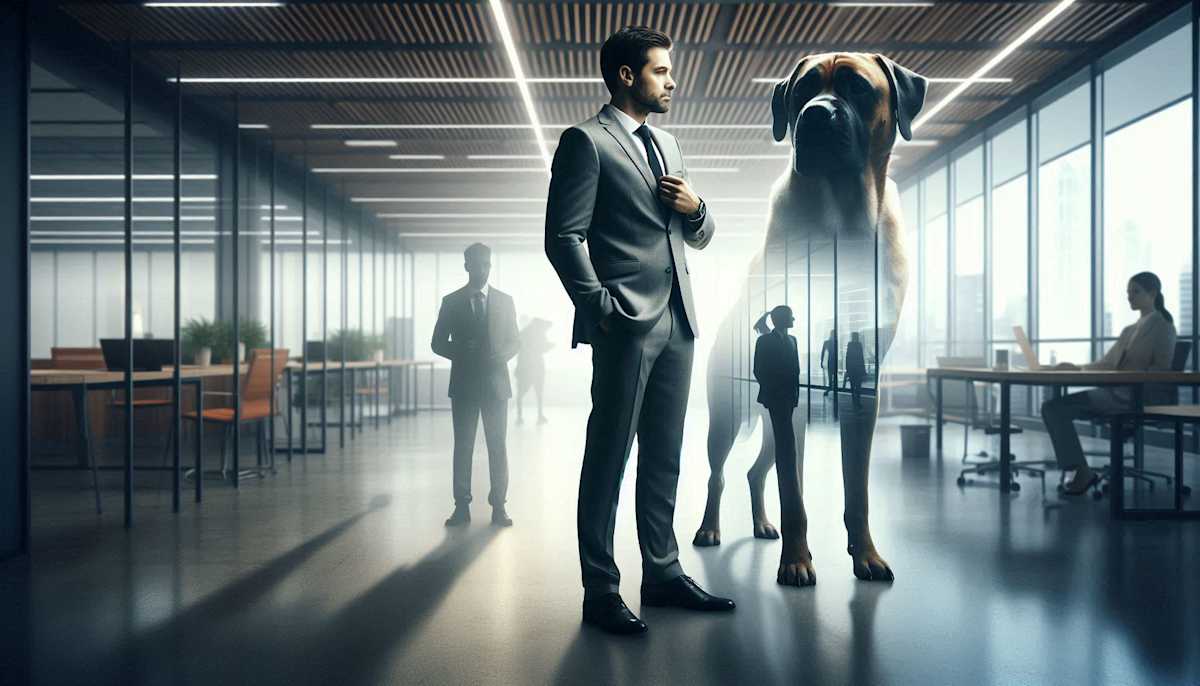
At work, two individuals often operate together. In my mind, the taller one is a Bullmastiff — calm, imposing, pushing his agenda through sheer presence. The smaller one is a Jack Russell — yapping, reactive, aggressive by volume.
Here’s the trick: challenge either directly and they retreat, regroup, and target someone else.
They appear harmless until they sense weakness. Then they pivot — predator to prey.
Once you see these archetypes, you can anticipate behavior. Spot triggers. Stay composed.
It requires vigilance. Awareness. And the understanding that beneath polished suits and friendly smiles, instinct still runs the show.
It makes me chuckle.
But it works.