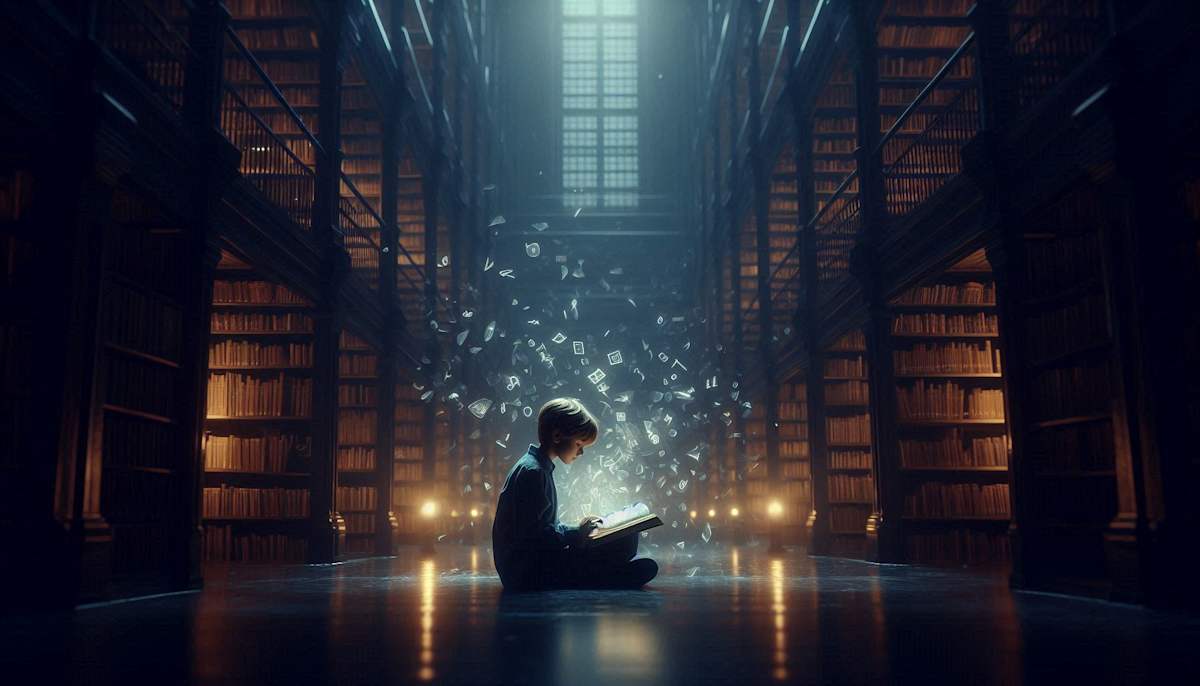
I started reading at such a young age that I don’t remember the exact moment. While I can recall learning how to read, it’s harder to pinpoint when I first began writing, or even when I spoke my first word.
My older brother preferred playing outside with his friends. While he was occupied, I’d sneak into his school bag and pull out his books. The pictures of farm animals were clear, with words beside them, missing a letter or two. I’d announce the animal’s name — “cat” — and trace my finger over the word. Then I’d choose a vowel from the letters above that seemed to fit and fill in the gap. I’d work my way through the pages, eagerly flipping ahead to see if I was right.
The joy I felt when I began getting them correct was immense.
I proudly announced the vowels: A, E, I, O, U.
Soon I was singing the vowel song, recognizing the shapes, the sounds, the patterns. It was a small moment, perhaps, but one that quietly shaped everything that followed.
I had no time for friendships — or perhaps I simply didn’t want them.
“Psycho in the making,” you might be thinking.
I won’t deny it; it does sound antisocial. Isolating myself felt like something death-row inmates might do. But back then, I didn’t realise how deeply wounded and traumatised I already was. Friendships felt dangerous — a way to expose myself, to invite pain.
And I did get hurt.
Not by friends, but by female teachers.
I won’t go into detail. Use your imagination. Being shy and distracted made me an easy target.
So I retreated into something safer: letters forming words, words forming sentences, sentences becoming paragraphs, paragraphs becoming chapters, chapters becoming books.
That was when I discovered libraries.
Heaven — or at least my version of it.
The world opened. I travelled beyond oceans, across galaxies, into imagined universes. I escaped pain by stepping into other lives. It was bliss.
The scent of ageing paper and ink, the symphony of silence broken only by turning pages — these became my companions. Within those towering shelves, I was no longer the awkward boy, but a voyager, a knight, a sorcerer.
Time dissolved.
Hunger, thirst, fear — all faded when I was lost in a story.
Days blurred into weeks. Weeks into months. My existence narrowed to a ritual: choosing a book, cracking its spine, breathing in the intoxicating promise of words.
The real world, sharp-edged and dangerous, receded.
Everything I learned came through words.
I discovered my father had abandoned us. That I had a sister I wouldn’t meet for fifty-four years. That she would later die of cancer.
I learned about my mother’s dating history. Even her evenings — which I wish I hadn’t.
I read school reports. Teachers’ opinions. Concerns about my “social development.”
Later, I learned why my father had left. What my mother had done.
Through words, I asked the prettiest girl in class out.
She said yes.
We became best friends, sitting side by side, reading for hours, sharing stories.
Her name was Julia.
Words gave me more worlds than any friendship ever could.
And then, just as easily, words closed those worlds.
Julia moved away. Distance formed a silent chasm no letter could bridge. The books gathered dust. Each title became a phantom limb of a shared life.
The comforting hum of knowledge was replaced by the static of unsaid things.
The world shrank inward.
Words — once abundant — became careful and rare.
I learned they were a double-edged sword.
They could heal. They could wound.
My first “Dear John” letter arrived early in high school, along with the truth about why we had moved towns. (For those unfamiliar: it’s slang for a breakup letter. Look it up — the origins are darker than you’d expect.)
Report cards and letters home became weapons too. They could delight or destroy — a lesson reinforced by more than a few deserved spankings.
For a while, I abandoned books and focused on surviving.
My ego was bruised.
I felt like an outsider.
Words, I realised, could hurt as deeply as they could save.
That understanding would later shape my writing more than any class or mentor ever could.
Not everyone found comfort in stories, I discovered.
Some found it in numbers.
Math. Science. Logic.
Numbers couldn’t lie. They couldn’t be twisted. They were predictable. Clean. Honest.
So I built a second refuge — a fortress of precision and certainty.
Over time, I learned to recognise coping mechanisms.
The number-people hid together in silence.
The word-people hid alone.
Both avoided intimacy.
Both feared being seen.
I belonged to the latter.
Eventually, I learned to analyse writing itself — to spot plagiarism, emotional collapse, substance abuse, grief — all hidden between punctuation and rhythm.
I learned to see ghosts in the ink.
A missing comma.
A repeated phrase.
A fracture in a sentence.
Each a reflection of something broken.
It became a morbid talent.
And a heavy one.
Empathy, I learned, has weight.
This shaped The Haunting of Serpent’s Manor more than I ever intended. I wrote it during a dark time, and the characters carry that truth. Readers felt it. The reviews reflect it.
Words matter.
But they are not whole on their own.