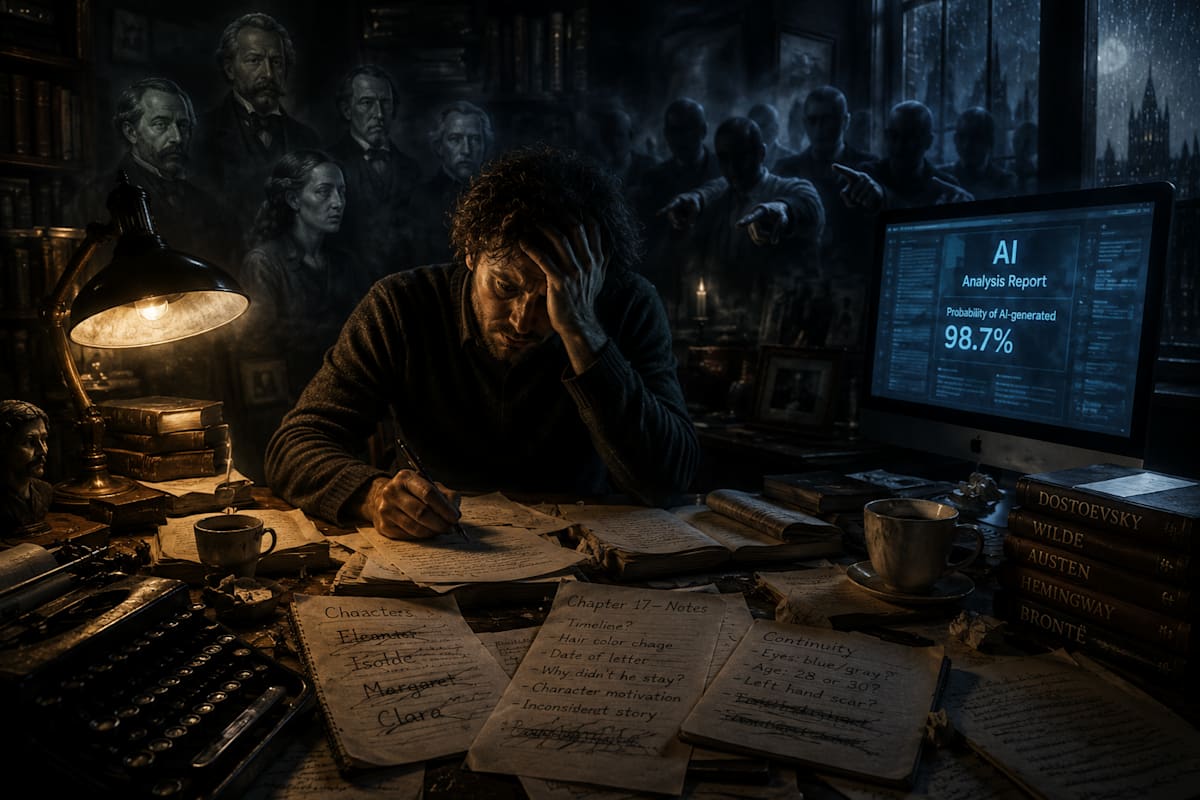
Let’s talk about a recent Verified Purchase review left for my latest book, Serenity Falls. The reader pointed out two continuity errors across the series. First, they noticed that in Book 1, Coby’s female dog was named Pippa, but by Book 2, her name switched to Janie. Second, they caught that in Book 4, a baby's gender and name shifted from a boy named Struan to a girl named Isla.
Then came the kicker: "Never had this happen in a book series. Are these written by AI?"
Welcome to the era of AI Paranoia.
The Flawed Logic of Modern Reading
We have reached a bizarre cultural moment where honest human oversights are weaponized as proof of technological fraud. If a name slips, an assistant editor misses a detail, or a writer loses track of an internal timeline, it is no longer viewed as a mistake. It is viewed as an algorithm glitching.
But if changing a dog's name or shifting a baby's gender makes a book "AI-generated," then history’s greatest human authors must have been time-traveling computers.
Consider the evidence:
- The Character Swap: In Stranger in a Strange Land, legendary sci-fi author Robert Heinlein completely lost track of a secondary character's identity, switching her name between Alice and Agnes throughout the novel.
- The Resurrection: In Book V of The Iliad, Homer explicitly has the warrior Pylaimenes killed in battle. Yet, in Book XIII, Pylaimenes miraculously reappears alive and well to weep over his fallen son.
- The Physical Mirage: In Robinson Crusoe, Daniel Defoe describes Crusoe stripping completely naked to swim out to a shipwreck. Two paragraphs later, Crusoe is actively filling his pockets with salvaged biscuits.
Humans have always been beautifully, consistently flawed storytellers.
Why Indie Authors are the Targets
As an independent author, budget constraints are a reality. When you cannot afford expensive development teams, keeping track of every thread across a sprawling five-book landscape like The McTavish Chronicles rests entirely on one pair of human eyes.
The irony is that modern generative models are actually better at maintaining strict data spreadsheets of character names than tired human brains working late into the night. It is the humans who forget, who mix up the details, and who accidentally rename a dog.
A Final Test
To prove exactly how easily the human mind overlooks details while focusing on the broader picture, I have included a deliberate, verifiable error in the famous literary examples listed earlier in this post. One of those literary blunders did not actually happen the way I described it, yet your brain likely glided right past it, accepting it as truth.
Which brings me to my final question.
Reader, please tell me this: Was this article written by an AI agent, or me?