This wasn’t the first time I had experienced something mysterious.
Similar strange occurrences happened to me both before and after the Soweto massacre. Most have faded with time, but a few remain vividly etched in my memory. I’m sharing these experiences for the first time now, and it feels unexpectedly freeing. I suspect many others have witnessed things they cannot explain, yet remain silent, fearing how they might be received.
Shortly after my narrow escape from Soweto, I decided to take a long-overdue leave.
Until then, I had either “sold” my leave to comrades or simply never taken it. By “sold,” I mean no illicit trade — it was common practice among soldiers, a kind of barter system. Things civilians take for granted become rare luxuries inside barracks. A weekend pass was one of them, and I had accumulated several.
Distance was the main reason. With our meagre salaries, owning a car was impossible, and even if it weren’t, there was nowhere safe to keep one. Hitchhiking in uniform was our only option. Most drivers — especially women — would flash their lights or screech to a halt to pick us up. They said it was for company, but we knew better. That alone made leave a valuable commodity.
On the eve of my departure, my celestial visitors returned.
The same three beings — eyes like burning coals, gilded belts, crisp white robes, chest plates that doubled as shields. The tallest stood before me, the others flanking him. I use “he” only for convenience; I could never determine their gender.
I lay frozen on my bunk, staring at them.
“Hello,” I managed, offering a shy smile and an awkward wave. Years earlier, one of them had spoken, delivering a warning. This time, they were silent — yet their presence spoke volumes.
The air thickened, not with fear, but with reverence. A stillness settled, heavy with unspoken meaning. The tallest being’s gaze seemed to take in everything at once — the room, the stars beyond it, and my small, temporary life.
It was mesmerizing. Paralyzing.
Then, as before, they were gone.
I fell into a deep, tranquil sleep and woke at dawn to the alarm.
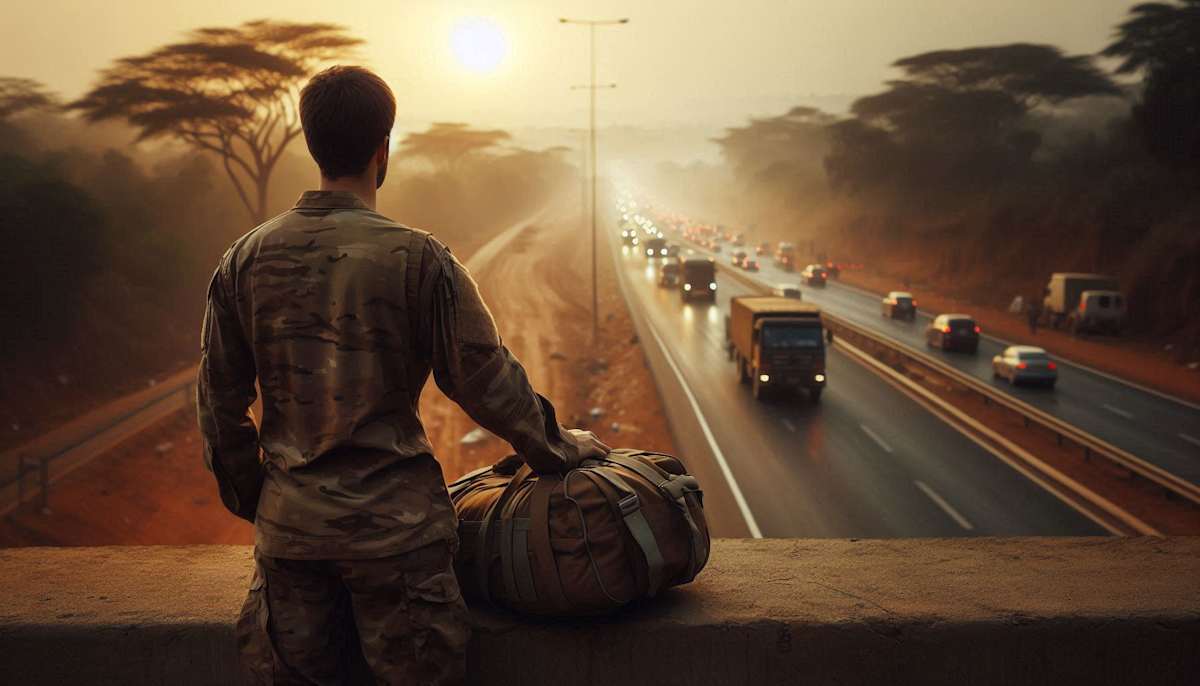
Their presence lingered in my thoughts as I dressed in my step-outs uniform, placed my flight cap on my head, and slung my duffel bag over my shoulder. A friend had promised to drop me near the highway while collecting the K-9 unit.
Soon, I stood outside Pretoria, an orange reflective sash across my chest.
We weren’t allowed to hitchhike just anywhere. Signs marked designated spots — little silhouettes of soldiers with thumbs raised. We were forbidden to flag down cars. All we could do was stand, smile, and hope.
Rush hour thickened the traffic into a restless river of metal.
From experience, I knew it would take five rides to get home, plus a long walk. I was bracing for that when I noticed something wrong.
A vehicle was accelerating straight toward me — too fast. Far too fast.
Instinct took over. I grabbed my bag and threw myself down the embankment, tumbling until the world stopped spinning.
The taxi roared past.
Its passengers leaned from the windows, fists raised, middle fingers extended, hurling insults in their language. In South Africa, a “taxi” isn’t a yellow cab or a black carriage — it’s a Toyota Hiace minibus, the backbone of public transport.
I climbed back to the road, shaken.
An Audi A4 stood waiting, its door open.
“Maak gou, troep!” the driver barked.
Roughly translated: Get in. Now.
I obeyed.
He launched the car forward, weaving through traffic like a missile. A car phone sat beside him — rare, then. He dialed while driving at a speed I’d rather not remember.
I watched him give a license plate number.
He lit a Lexington cigarette.
Gestured for coffee.
Then, without warning, reached across me and pulled a pistol from the glove compartment.
Minutes later, we reached Johannesburg.
Police vehicles clustered beneath a bridge, blue lights flickering like electricity in the fog. As we exited toward the N12, I looked down.
The taxi sat abandoned. Its driver and passengers lay face-down on the tarmac, hands cuffed.
I leaned out the window and returned the gesture they had given me.
On the bumper: Jesus Saves.
I survived another day.
And gained another story to tell.
For that, I am grateful.