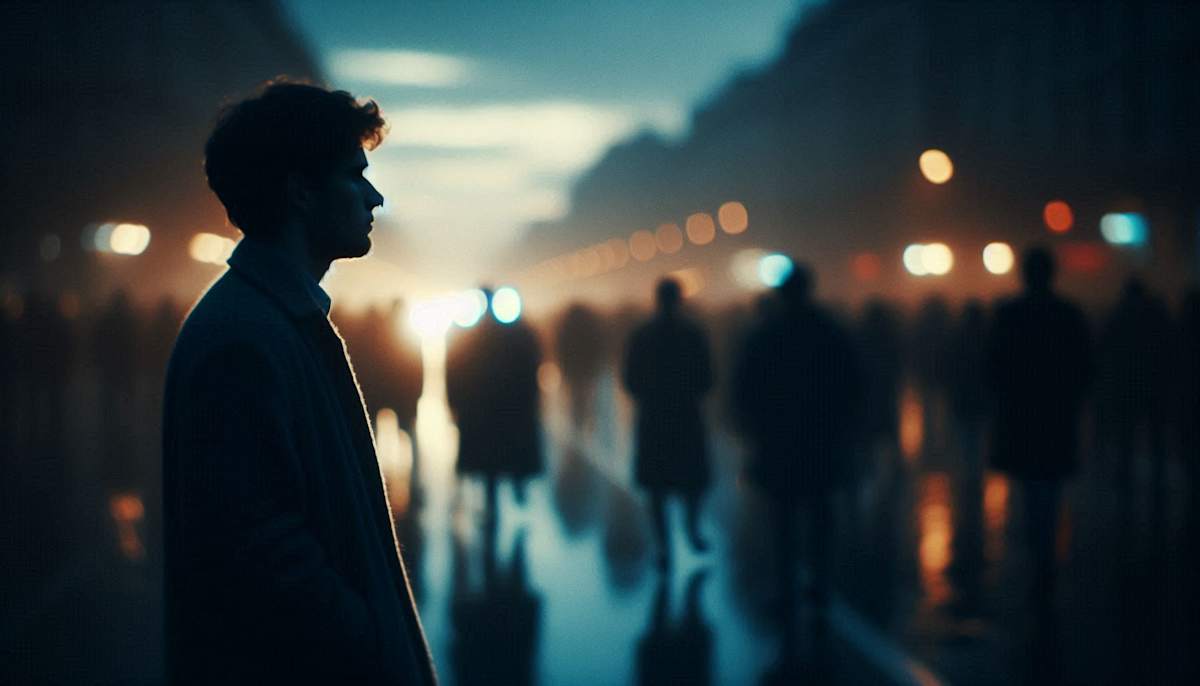
I have often felt as though I do not belong, as if I were shaped slightly differently from the spaces I am meant to occupy.
It is not a fleeting feeling, and I cannot trace it back to a single moment or place. It has simply always been there — a constant companion moving quietly beside me. It feels stronger now, sharper in adulthood, but when I look back, I can see its outline clearly in childhood too.
I remember the boy who sat alone in the courtyard, eating his sandwich.
Weirdo, I heard them say as they passed.
Most days I did not even notice. I was too busy living somewhere else — watching ants navigate cracks in concrete, memorising the shapes of clouds, constructing private worlds in the quiet corners of my mind. I was the child who watched others play games and never joined in. The one who hummed to himself while drawing a family portrait of people he did not know: crayon smiles stretched across wide paper, the sort of picture grandmothers display on their fridges and praise to visitors over tea.
And yet I was not particularly bothered. That is perhaps the strangest part.
Loneliness, for me, was never a wound. It was familiar. Not something to be cured, but something to sit beside. It existed alongside a gentle contentment, a calm acceptance of my solitary state. Perhaps I was too immersed in imagined conversations and whispered stories to notice what I was missing. Or perhaps, even then, I understood something fundamental: that fitting in is not the ultimate destination. That a quieter path, less crowded, might still hold its own wonders.
So I continued as a silent observer in the grand theatre of life.
School plays were watched from the back row, never the stage. Parties held no allure; their noise reached me only as a distant vibration. Friendships formed and faded around me, their roots never quite reaching my soil. There was no envy. No desire to rewrite the script. Only a profound detachment.
I collected experiences the way some people collect stones — small, rare, and beautiful in isolation. I never tried to build anything grand from them. The world revealed itself to me as a kaleidoscope, endlessly shifting, endlessly fascinating, and I remained the patient eye pressed to the glass.
Adulthood arrived, demanding I mature.
My body obliged. I aged well, like a decent bottle of wine left undisturbed. My friends, meanwhile, acquired beer bellies and the soft rearrangements of post‑parenthood. I remained more or less unchanged, carrying a youthful face and a heart that never quite caught up with the calendar.
The truth — and this may surprise you — is that I miss those earlier days.
Not because they were joyful, but because they were simple. The ache was quieter then. I was less aware of it. Life consisted of school corridors, bicycle rides, strategic avoidance of conversation, listening in class, watching other children collide joyfully with footballs and scraped knees. I was always the outsider, always standing just beyond the circle, but it was easier. I had time. I was not expected to participate.
Detachment came naturally.
Peer pressure never found me. No one tried to get me drunk or drag me into mischief. I suspect they were wary of me, uncertain what I might become, unsure where to place me in their taxonomy of boys.
As the years stacked themselves into something resembling adulthood, the echoes of those uncomplicated days grew louder. Responsibilities multiplied, demanding a performance I had never rehearsed. The kaleidoscope began to spin too quickly; its colours blurred into routine. The stones I had collected grew heavy in my pockets — proof of a life carefully observed, yet only partially lived.
Still, the youthful heart remained. Untouched. A small lighthouse blinking stubbornly in a landscape of invoices, expectations, and obligations. It did not yearn for the past itself, but for the clarity of that old gaze — the privilege of anonymity, the safety of being unseen.
Now, my life bears little resemblance to the future I was meant to inherit.
As children, we are taught to want: success, influence, money, admiration. We are told wealth is a synonym for happiness. Careers become ladders. Dreams acquire price tags.
But I never wanted those things.
I wanted to make people feel better.
I wanted to offer what I did not have as a child: ease.
And somehow, that desire shaped my work. I fixed computers. I watched anxiety dissolve from faces as screens flickered back to life. People called me a genius. They asked how I did it. I blushed. The wealthy thanked me because they hated inconvenience more than expense. The religious blessed me while quietly forgetting their wallets. It all blurred together into a strange economy of relief and gratitude.
For the first time, I felt something resembling usefulness.
As a self‑declared geek, I was allowed to be different with purpose. And in that difference, I found something close to belonging — perhaps not permanent, perhaps not perfect, but real enough to rest my hands upon.
Looking back now, I can see how fragile the path has been.
There were failed relationships. Careers that collapsed politely. Friends who drifted, vanished, died. Periods when my own mind turned against me. Houses packed into boxes. Cities entered and abandoned. The death of my sister. The quiet disappearances of others who once anchored me.
Through all of it, something remained.
Not religion — you may lower your eager hands.
Words.
Writing became the thread that stitched my scattered years together. Through stories, I could offer what I never knew how to give in person: emotion without interruption, understanding without performance, presence without proximity.
Readers tell me they feel joy. Or fear. Or hope. They tell me my stories accompany them through grief, through boredom, through long nights and longer silences. Sometimes they say the words linger after the final page, like a voice echoing down an empty corridor.
That, I think, is the true magic of storytelling.
Not to entertain. Not to impress. But to remain.
To leave something behind that proves, briefly, unmistakably, that we were here together.
And in that quiet exchange, across distance and time, I finally understand:
I belong.