This story is entirely based on real events. Nothing has been altered to protect anyone, because the truth requires no embellishment. The only exception is if your biological mother happens to be in hiding, in which case this fact may be gently softened to account for her decisions.
I joined the army — now known as the Defense Force — during a turbulent period in our nation’s history. The world (except, perhaps, Americans, who often see their nation as the world) knows Nelson Mandela’s story. Many regard him as a legend, a force of nature, even a hero.
Others do not.
By “others,” I mean those who lived here at the time. Those who experienced its raw edges. Those who lost people. And then there were us — not in civilian clothes — who chose to protect ordinary citizens during a season of genuine unrest. Including, I should add, the elegantly dressed ladies who passed our patrols and offered a pleasant distraction from the tension. Simply lovely.
During my time in the Defiance Force, I witnessed things that remain burned into me. They still surface, uninvited, decades later. As a writer, I struggle to articulate them. I doubt language is sufficient. Some experiences resist sentences. They only exist properly when shared.
To explain what follows, I need to step back.
Most young men finish school and then join the army. While my friends spent their holidays at the beach, I travelled four hours inland to a small town where a quadriplegic man lived alone with his Black assistant.
His name was Lane Flint.
I stayed in his home and cared for him. The work was physically demanding, relentless at times, but it offered me something rare: the privilege of watching him write.
He owned an ancient typewriter. He could not change the paper himself. I did that. I helped him hold a pencil between his teeth, which he used like a bird pecking at grain, tapping letters into existence as the metal arms punched ink into the page.
Once he settled into his rhythm, I unpacked my ZX Spectrum computer, connecting it to the television and the tape drive. When it finally hummed to life, I typed deliberately, knowing he was watching.
He was astonished.
He learned that a dot-matrix printer could be attached — that this machine could do in an hour what took him an entire day. My holidays became sacred. With the time he saved, we even went on picnics.
I miss him still.
Lane Flint was, and will always be, my role model. Not because he instructed me, but because he quietly bent the direction of my life toward words.
When his book was published, I received the first signed copy — not his assistant, who could not read, because at that time education was a privilege reserved for white children. I read the book aloud to Lane.
I could not have known then how heavy its title would become in my life:
God’s Miracles Versus Marxist Terrorists: The Epic True Story of Men and Victims Who Fought the Rhodesian and South West African Wars.
In it, he described strange mysteries witnessed by soldiers in battle. One story, in particular, never loosened its grip on me.
That is why he called me Troepie — young soldier.
Back to the future.
I lay in a military bungalow with my comrades, listening to the familiar orchestra of sleep: snores, farts, grunts, scratching. I stared at the ceiling while my thoughts ignited and collapsed like brushfires.
I thought about the guards in the towers. The patrol vehicles. The coffee. The K-9 meals. The security gate. The weekend passes.
There was a reason these responsibilities were mine. I will explain later.
At the time, I was what they called a Pongo — trained in specialized weapons and crowd-control tactics, taught to scale skyscrapers like an insect, neutralize hostage situations in seconds, not minutes.
But even soldiers need protecting.
You know those ones — neat haircuts, camouflage fatigues, blue berets?
That was me.
I also carried a particular license.
Shhh. We’ll get there.
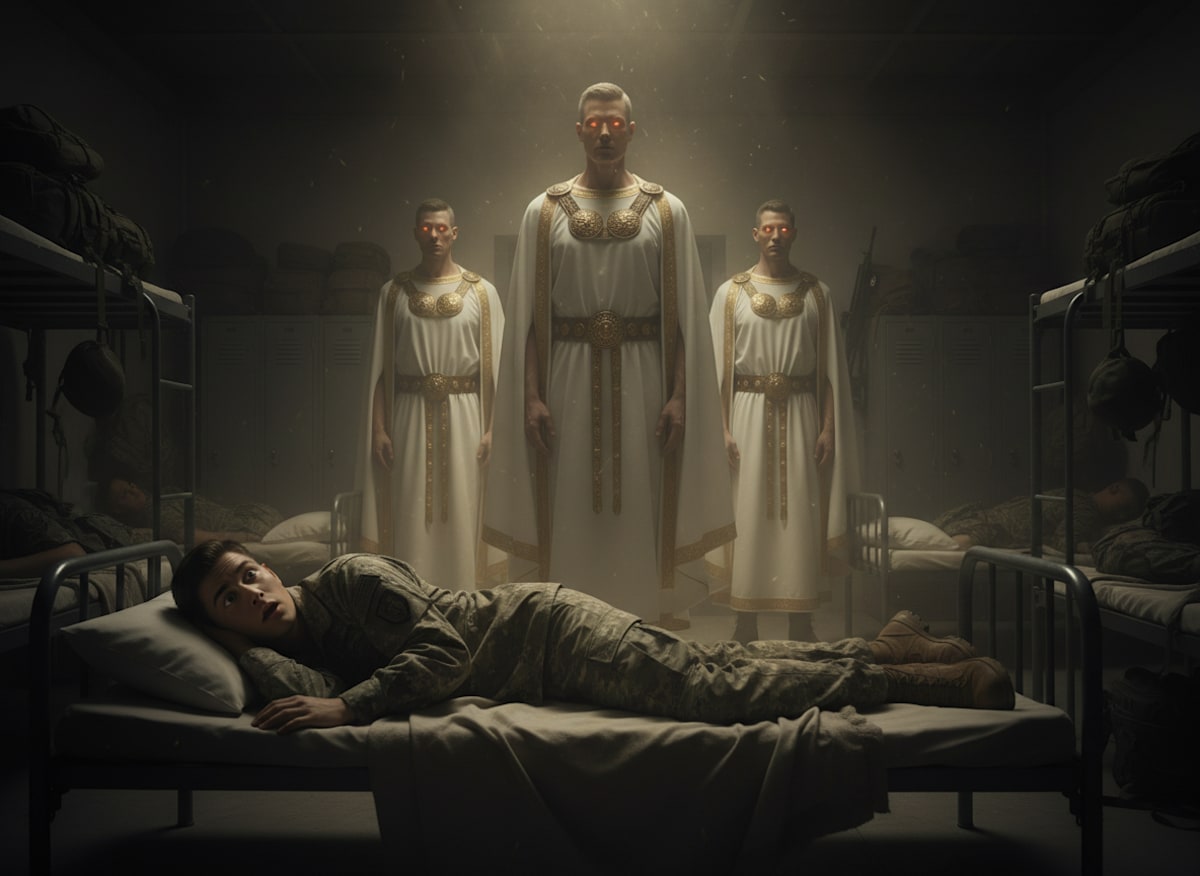
Sixteen of us slept in a long rectangular bungalow, divided by tall pea-green metal cabinets stuffed with rifles, uniforms, letters from home, and secret snacks. Our assignment was Oscar. I would have preferred November, but that bungalow stood empty. Former occupants claimed they had seen things there. Ghosts, maybe.
Unofficially, we knew the gay soldiers used it for secret meetings. Their existence was forbidden then, punishable by the DB — detention barracks.
This is not a Hollywood war film. Not Charlie Sheen. Not Platoon. Stay with me.
And for the record, I had not smoked any “mountain cabbage” before what happened next.
The base had no streetlights. Darkness lived there properly.
As I breathed and blinked, something flickered above me.
Three figures formed out of the dark.
The one in the center was impossibly tall — his head brushing the ceiling. Their eyes burned like molten pools. I could not move. Not from fear.
From awe.
They wore white garments like ancient Roman soldiers, trimmed in gold. Heavy metal belts hugged narrow waists. Circular breastplates shimmered on their chests.
They stared at me.
Then they dissolved.
Their absence left behind a scent — musky, metallic, intoxicating, as though their skin itself had been breathing perfume.
The air vibrated. A low frequency hummed through the room. Gooseflesh climbed my arms. My tongue tasted iron and flowers. My breath became visible in the darkness.
“Smitty,” I whispered.
He stirred.
“Did you see them?”
He sighed and turned over. Snored instantly.
“They’re back,” I murmured to myself, smiling.
And then I slept.
The deepest sleep I had known since childhood.
Return for the next instalment, where I explain who they were… and why they came.