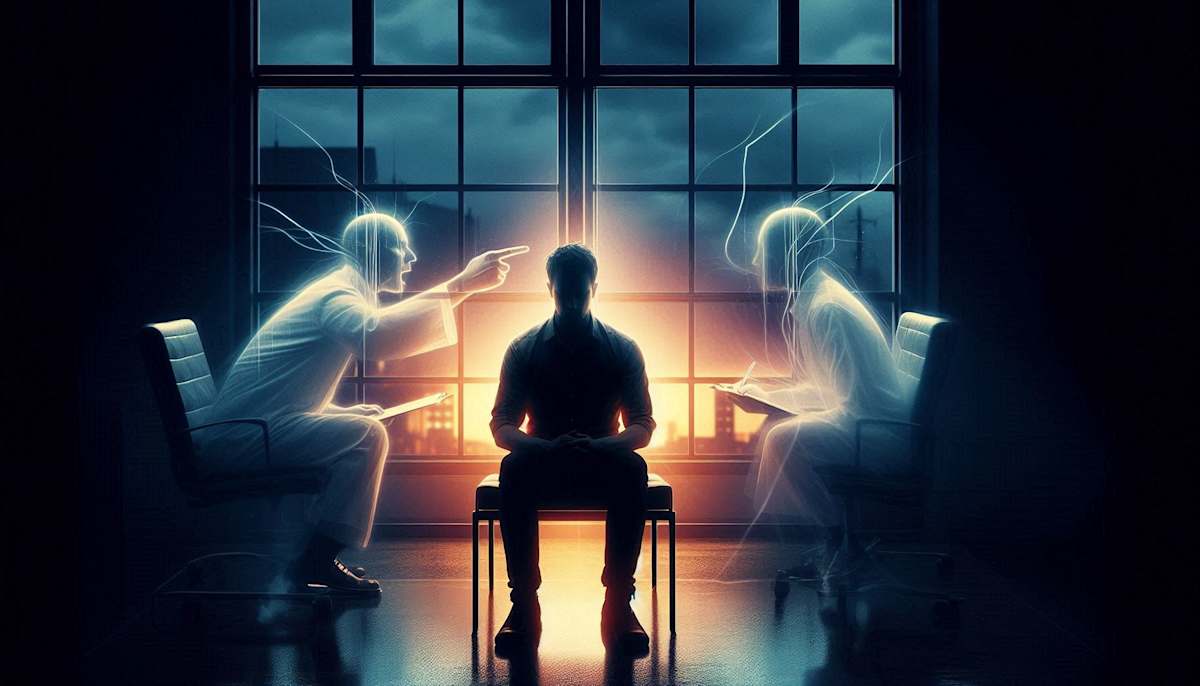
Every story has three sides: his, hers, and the truth.
No more. No less.
I’ll use gender-neutral pronouns here, because this pattern belongs to all of us. Most people have lived it—either as participants or silent witnesses. One side tells a carefully edited version, shaped to protect the self. The other offers a counter-narrative, equally sincere, equally biased. Between them sits something far less comfortable: the truth. Often ignored. Often avoided.
I’ve been on both sides—defending myself, or quietly sharpening my arguments. You probably have too. We see this dynamic play out between parents and children, managers and employees, partners and friends. The third side is the one that matters most, and the one we resist hardest. It demands vulnerability. It dismantles certainty. It refuses to flatter.
Let me show you what I mean.
This happened during a difficult period when I was unemployed, following severe burnout.
“Why aren’t you taking your meds?” she asked, her voice sharp.
I shrugged, staring out the window.
“Someone said you had another episode.”
I frowned.
“Please don’t have a breakdown out there.”
Then came the next blow.
“You’re delusional.”
The word landed heavily. I raised an eyebrow, masking the sting.
“You’re too sensitive. You need to toughen up.”
I smiled faintly, because part of me believed her.
“You have bipolar II.”
I didn’t argue. Something already felt wrong, but I was too vulnerable to push back.
“It’s hard for people like you to make friends.”
I said nothing. Tears gathered. I had none.
I could go on. Anyone reading this would assume I’m the victim, and she’s on the offensive. And from this perspective, that assumption makes sense.
Now let’s reverse the roles.
The forensic psychiatrist sat in her study, reviewing her notes as she waited for her patient. He arrived late, heavily medicated, unshaven, smelling strongly of mouthwash. This wasn’t his first visit. He’d been instructed to take his medication beforehand. He hadn’t.
She saw a broken man—his injuries largely self-inflicted. She’d worked with patients like him before. Experience had taught her that honesty mattered more than comfort. Time was not on his side. Medication compliance was essential. Monitoring was non-negotiable.
She gestured to the worn leather chair.
“Sit.”
Her voice was calm. Firm.
He obeyed, collapsing into the seat as though gravity had doubled. She noted the tremor in his hands, the flatness in his eyes.
“Let’s talk about what’s been going through your head,” she said evenly, “and then we’ll make a plan to keep you safe.”
Two perspectives. Both believable. Both incomplete.
Now comes the third.
Yes, she diagnosed me with bipolar II, and I accepted it—desperate for relief, for explanation, for escape. I was wrong not to question it. Wrong not to seek a second opinion.
What she didn’t know—and never asked—was that I had sat in that same study years earlier. Back then, a different psychiatrist diagnosed me with schizophrenia.
That contradiction stayed with me.
Much later, alone one evening, I searched for the common thread connecting both experiences. What I found surprised me.
Magnesium deficiency.
A simple, unglamorous answer.
Severe magnesium deficiency can contribute to anxiety, panic attacks, depression, and in extreme cases, psychiatric symptoms that mimic psychosis. Magnesium plays a critical role in regulating the nervous system. When it’s absent, the body can slip into neurological overdrive.
This was my third side of the story.
Not his.
Not hers.
But biology.
The truth, as it turns out, doesn’t always belong to a person.
An Invitation
If this story stirred something in you — if you’ve lived through a moment where his truth, her truth, and the actual truth collided or quietly passed one another — you’re not alone.
I believe many of us carry versions of these stories. Misunderstandings. Diagnoses. Labels. Moments where we were certain we were right, only to learn later that the truth lived somewhere else entirely.
If you feel moved to share your own experience, you’re welcome to reach out. With your explicit permission, I may publish selected stories on this site, anonymously or credited — entirely your choice. What matters is care, honesty, and respect for where you are now.
Some truths are lighter when they’re shared.