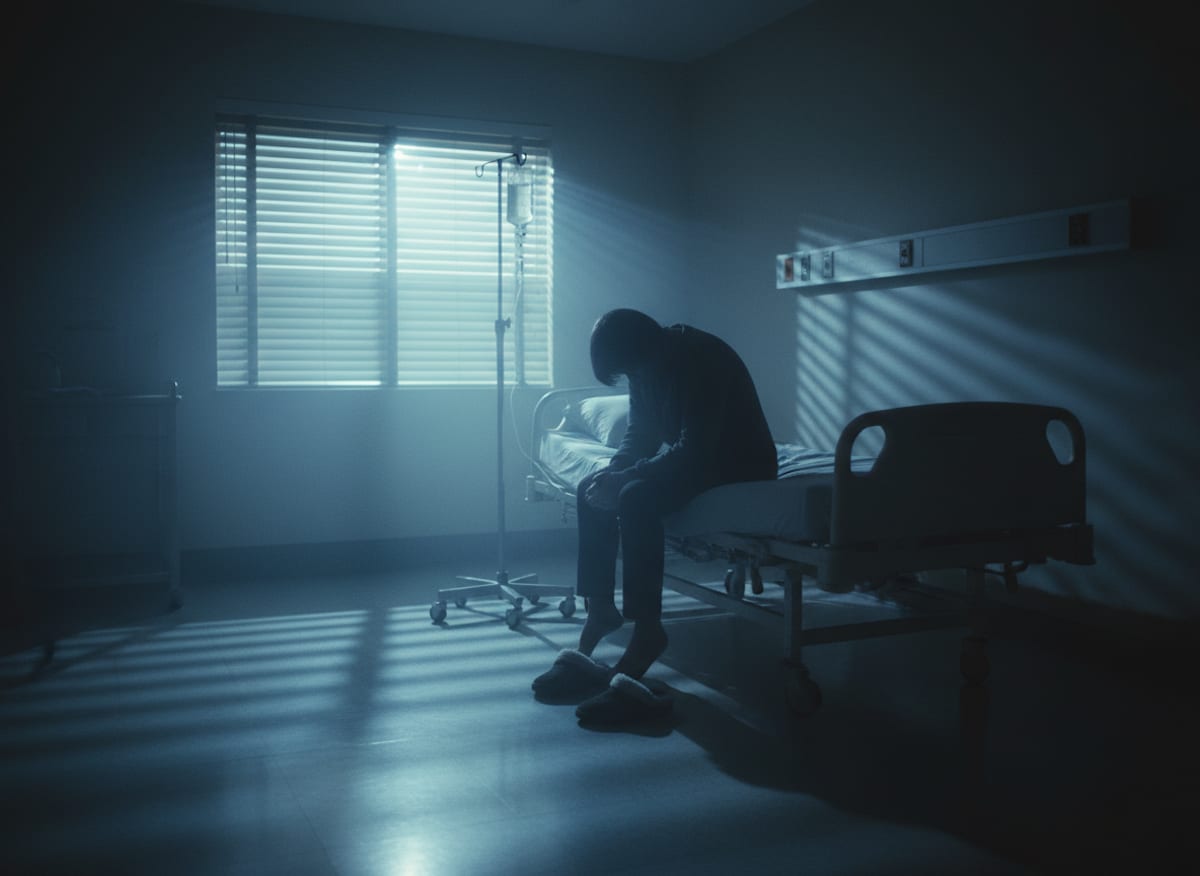
A breakdown, a blackout… and the strangest homecoming I never asked for.
I don’t remember deciding to stop functioning.
My wife tells me I sat up in bed—eyes open, breathing shallow, staring at the wall like someone had unplugged me mid-sentence.
“Elmo?”
Nothing.
“Elmo!”
Still nothing.
She shook me hard enough to rattle the universe, but whatever part of me that cared had already packed its bags and left the building.
The next flicker of memory comes from a different world: bright hospital lights streaking overhead as I was wheeled toward Radiology at 4 AM. A machine swallowed me; another machine hummed; neither seemed particularly impressed that I was dying in my own head.
Then — nothing.
Blank.
Black.
Gone.
When I resurfaced two days later, it was in a narrow bed surrounded by three strangers whose snoring could’ve powered a small mining town. My tongue felt like old carpet. My brain was still drowning in sedatives. But I knew enough to whisper the first truth of the day:
“Shit… I’m back.”
I dragged myself out of bed, leaning on whatever furniture I could grab, limping toward a smell that promised salvation.
Coffee.
Or something pretending to be coffee.
Didn’t matter.
I staggered into the Sereno Clinic kitchen like a zombie extra who got promoted without warning. A nurse spotted me and sprinted over — not with admiration, but with the panicked energy of someone who just discovered a resident wandering the halls unsupervised.
She sat me down. Handed me water. Told me I was in a psychiatric clinic.
“Cool,” I thought. “But where’s my coffee?”
She pointed me toward a woman sitting at a nearby table.
A pretty woman.
Soft smile.
Kind eyes.
“Hello Elmo,” she said gently, reaching for my hand. “How are you feeling?”
And I — with all the grace of a tranquilized walrus — snapped:
“How do you know my name?”
She froze.
Her eyes filled with tears.
Because the stranger I was talking to…
was my wife.
Sedation does strange, cruel things.
I didn’t know her.
She didn’t recognize the man sitting opposite her.
We were two ghosts meeting in daylight.
A nurse dragged me back to my room. I swallowed whatever pills were handed to me and fell straight into another medicated abyss.
Day Two: The Sereno Romans
At 4 AM, the chorus began.
Not birds.
Not alarms.
Not nurses checking vitals.
Men. Full-grown, heavily sedated men, snoring like engines misfiring in different time zones.
This is where the “living dead” part enters the story.
Every room had its own cast. Mine featured:
- one schizophrenic who spoke fluent conspiracy,
- one bipolar patient who alternated between staring at walls and preaching to them,
- and one manic depressive who cried in his sleep.
These were my Sereno Romans — fellow soldiers in the land of mental limbo.
I sipped my morning coffee (finally), and made a private vow:
“I am not staying here a moment longer than necessary.”
Day Three: Enter the Psychiatrist (and the Game)
She invited me into her office — serene, quiet, clinical.
“Do you want a rundown of your prognosis?” she asked, voice gentle, but eyes sharp.
“No.”
I said it flatly.
Deliberately.
Because the last thing a drowning man needs is a list titled 'Ways You’re Sinking.'
I squeezed my juice box, letting drops fall on her carpet.
She wiped it up.
She wiped my mouth too.
My brain yelled:
“No way — a shrink with empathy?”
We stared at each other, both trying to read the other’s next move.
But I had one truth loaded, and it came out clean:
“I don’t want to know what’s wrong with me.”
She scribbled notes like she was diffusing a bomb.
Day Four to Six: Survival Mode Activated
While others overshared, cried, struggled, or spiraled…
I strategized.
I learned early in life that we become what we surround ourselves with — and let’s just say the Sereno Romans were not the future I envisioned.
So I:
- ate alone,
- arrived early so my meals were wrapped and labeled,
- befriended the staff (bribery: chocolates),
- convinced the nurses to give me the gym keys after hours,
- avoided the drama,
- observed everything,
- curated my appearance,
- and took every class, every lecture, every arts-and-crafts opportunity with the precision of a man who needed witnesses to his sanity.
I even gave the psychiatrist a signed copy of Elm Brook Manor and a chocolate bar.
A peace offering.
A reminder that I am more than my diagnosis.
A nudge that said:
“I’m functional. I’m aware. I’m going home.”
Day Seven: The Final Test
I woke early, dressed neatly, shaved, styled, prepared.
In the kitchen, I chose my target — a young woman recovering from an overdose, her head still wrapped from the EKG.
Not to manipulate.
But to prove life existed in me.
I engaged her warmly, naturally. My voice carried.
The psychiatrist summoned me moments later.
“I thought I heard your voice,” she said.
Victory.
I walked out with discharge papers, strict instructions, emergency numbers, and my wife waiting with her car.
We drove straight to St Helena Bay.
And that first beer —
after days among the sedated, the lost, the bleeding, the unraveling — tasted like the breath of God.
This is only Chapter One.