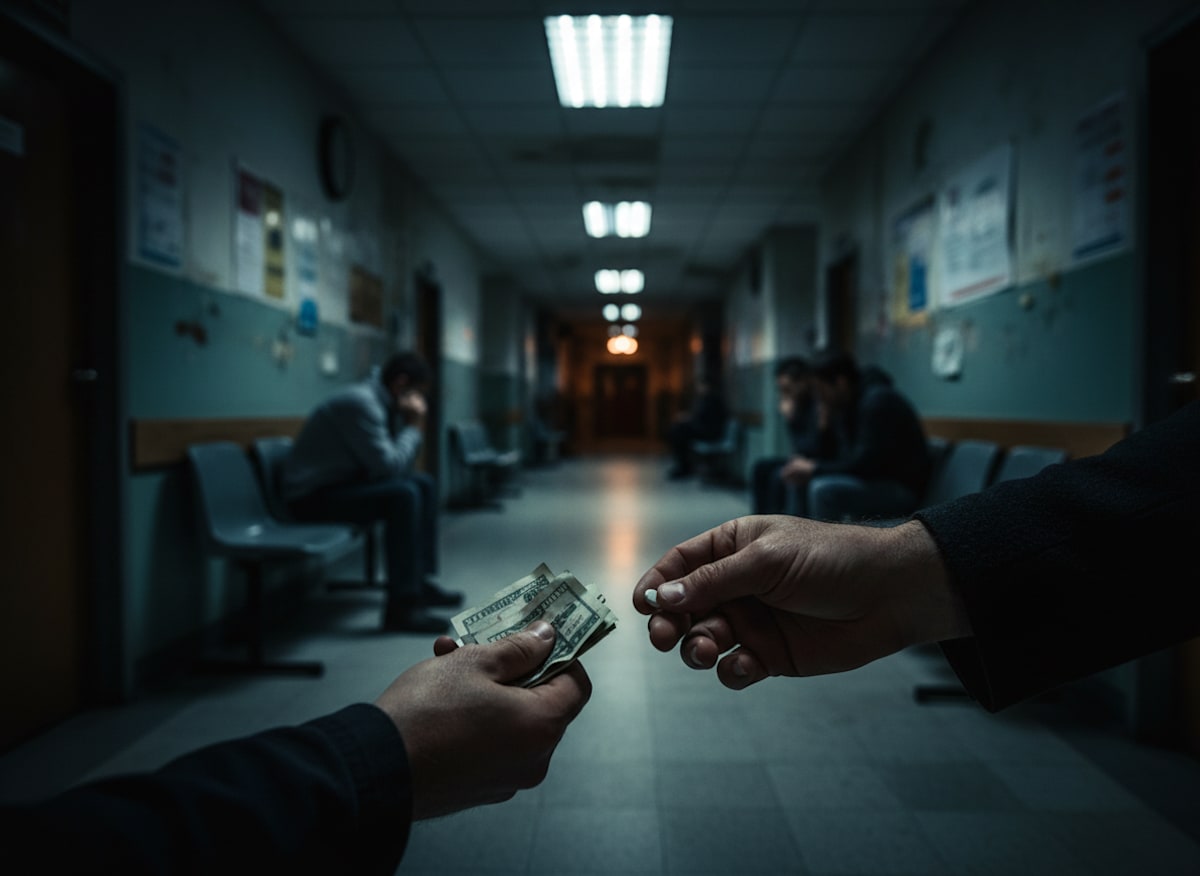
Too often, the very places built to protect us do the opposite.
Corporate environments lecture endlessly about “well-being” while executives hurl verbal assaults like deranged ice-cream men on a street corner. Everyone has a story. And mental health clinics — the institutions meant to heal — are no exception.
After a wrongful diagnosis from a doctor sent my brain spiralling into chemical chaos, I found myself admitted to such a clinic. What I discovered inside left me more shaken than the breakdown that brought me there.
At first, I thought nothing of the soft whispers I heard between patients — urgent, fragmented conversations that dissolved the moment I approached. The first two days were a medicated haze. But the whispers persisted. And slowly, the truth surfaced.
The First Warning
One evening, just after visiting hours, I stepped outside — craving fresh air before the dreaded “zombie zone” of night medication settled over us.
A young girl drifted closer.
“Hey, boomer,” she said.
I sighed. “Hey, zoomer.”
“Got insomnia?”
I nodded.
She lowered her voice.
“Swipe a fiver and I’ll slip you a pop.”
“I don’t speak Gen-Z,” I muttered.
She tried again.
“Give me fifty bucks and I’ll give you a sleeping pill.”
I stood up and walked away.
She called after me: “Hey, boomer!”
I turned just long enough to see her press a finger to her lips and drag her thumb across her throat.
A threat.
A warning.
A transaction.
Later, I learned the stakes. Selling medication inside the clinic meant immediate dismissal — and medical aid would refuse to pay. Patients would shoulder the full cost, and these places are priced like five-star hotels. That financial destruction kept everyone silent.
The Second Reality
As clarity returned to my mind, my senses sharpened. One afternoon, during an occupational therapy lecture, I sat at the back of the room. I didn’t want to draw attention to myself — especially not from the two beautiful young women whose smiles were far too inviting.
Let me say this bluntly:
Avoid romantic entanglements in mental health institutions.
They end badly. I learned this years ago, and even wrote about it in my memoir.
But back to the room.
From the corner of my eye, I saw it:
Quick movements.
Hands exchanging notes for sachets.
Micro-transactions happening right under the therapist’s nose.
The bile rose in my throat.
I excused myself and left.
The Deep End of the Underworld
With my journalist instincts creeping back, I began observing carefully. Mapping behaviours. Identifying patterns. And then—my opportunity.
Right after dinner one evening, I approached a woman I had noticed often: older, quiet, eyes that had seen too many returns.
“Does she call you Nana or Granny?” I asked, after glimpsing a baby photo on her phone.
She startled — but she took the bait
Turned out it was her eleventh admission. She knew this place inside out.
Over the next hour, she told me stories. Dark ones.
She confessed to taking double her daily prescriptions and explained exactly how patients acquired the extra pills. She even hinted at how “mert” — their code word for contraband medication — moved through the clinic.
I won’t reveal the method.
Not because I fear consequences for myself, but because I refuse to teach anyone how to harm themselves.
This piece is not a guide.
It is a caution.
A warning.
A truth too few are willing to say aloud.
The Final Scene
On the day I checked out, the head nurse performed the standard audit of my belongings — including the medication I brought with me on admission.
The psychiatrist had told me I should no longer use them, except for one.
I watched the nurse count the pills with the skill of a street magician. He tried sliding certain boxes into a plastic bag meant for “recycling.”
“No, not those,” I said sharply.
He froze.
I smiled.
“I want to keep it as a souvenir.”
Reluctantly, he handed it over.
As we walked toward the exit, I added:
“You can keep the others for your little underworld, black-market scheme you’ve got going here.”
He stammered nonsense assurances until the door clicked shut behind me.
I drove away, breathing freely for the first time in days.
And smiling — because I knew I had a story waiting to be written.
If You Are Reading This
Be careful.
Be aware.
Not all danger wears a villain’s mask. Some wear scrubs. Some smile. Some hand out sleeping pills for fifty bucks behind a shrub.
Healing institutions are essential — but they are not immune to rot.
And if you have a story of your own…
You are not alone.