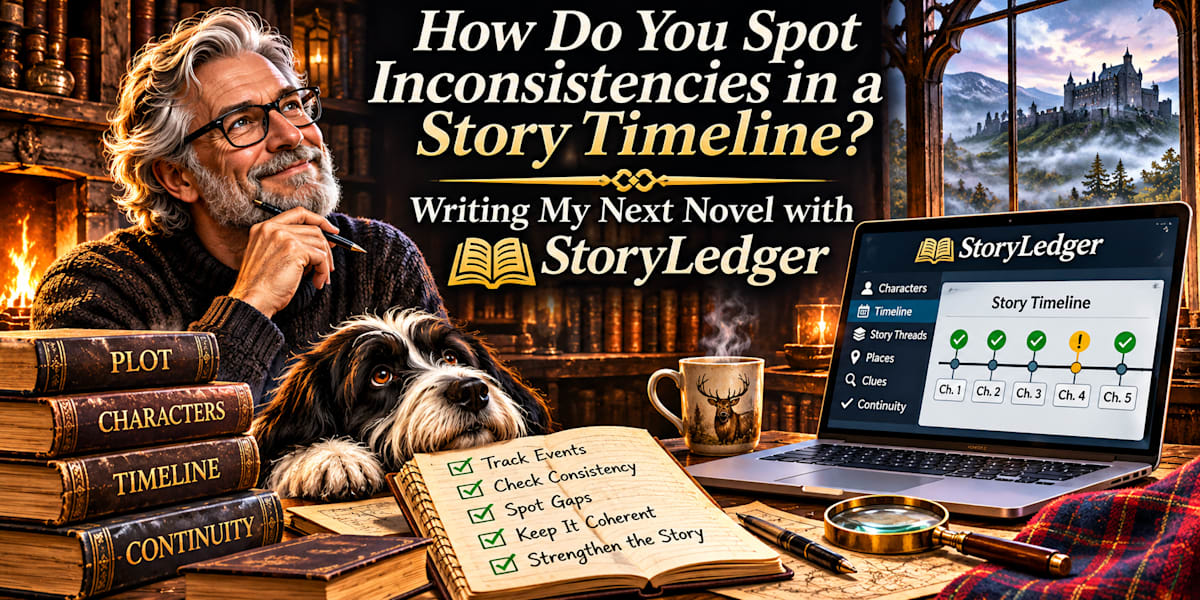
I couldn't find the novel-writing software I needed. So I built it. Now I write with my characters, timelines, research and continuity records beside me.
There is a peculiar moment in writing a long-running fiction series when you realise that your greatest challenge is no longer coming up with ideas.
It's remembering what you've already written.
What colour were that character's eyes? When did the detective discover the letter? Was the old lighthouse abandoned before or after the storm? And how could somebody remember a conversation that took place before they were born?
For a mystery writer, these aren't insignificant details.
A single contradiction can undermine a carefully constructed plot.
And when you're writing the eighth novel in a series, the problem becomes considerably more complicated.
I know because I've been there.
In fact, that frustration is precisely why I built StoryLedger.
I Was an Author Looking for a Writing Tool, Not a Software Developer Looking for a Project
As an independent author of Scottish Gothic ghost mysteries, I've spent years creating interconnected stories, characters, locations and historical events.
My novels frequently revisit familiar characters. A seemingly insignificant detail in one book might become important several novels later.
And I enjoy that complexity.
What I didn't enjoy was trying to remember where I'd stored everything.
Character descriptions lived in one folder. Research occupied another. Timeline notes were somewhere else. Plot threads, clues and relationships were scattered across documents that seemed perfectly organised until I actually needed something.
Then came the familiar ritual.
Stop writing.
Open another folder.
Find the right document.
Search for the relevant detail.
Return to the manuscript.
Try to remember what I was writing before I interrupted myself.
By the time I found the answer, the momentum had often disappeared.
I began to realise that I didn't simply need somewhere to store my research.
I needed the information to appear while I was writing, at the moment I needed it.
I explored the writing and planning tools available to me, but couldn't find one that brought together everything my particular workflow required.
So I decided to build it myself.
That decision eventually became StoryLedger.
What Does It Feel Like to Write a Novel Inside StoryLedger?
I'm now drafting the next instalment that will bring together the stories of The McTavish Chronicles and The Highlands University of Ghostology in one final conclusion.
That means returning to characters, events and unresolved story threads established across multiple novels.
It's exactly the sort of project that once would have sent me searching through a small mountain of notes.
But my writing routine has changed.
Today, I open StoryLedger and go straight to The Desk.
My chapters and scenes are listed on the left. My manuscript occupies the centre. And on the right, the details of my fictional world are waiting.
Characters.
Places.
Timeline events.
The information I used to hunt for is now part of my writing environment.
And here's the part I particularly enjoy.
As I write, StoryLedger recognises names that I've already recorded and brings the corresponding information into view.
If I mention a character, I can consult their details without abandoning the scene.
If I return to a familiar location, its recorded information is beside me.
If an important timeline event comes into play, I can refer to the date and surrounding details.
The application doesn't invent any of these facts.
It simply remembers what I've already recorded and puts that information where I can see it.
For the first time, I feel as though I'm writing with my entire story beside me.
Can You Spot Inconsistencies in a Story Timeline Before Readers Do?
This is one of the questions that led me to create StoryLedger.
And it's a particularly important one for mystery writers.
Imagine a fictional investigation involving a missing person.
A witness claims to have seen someone on a Tuesday evening.
But three chapters earlier, you've established that the witness was in another town until Wednesday.
Perhaps the contradiction is intentional. Perhaps the witness is lying.
Or perhaps you've simply made a mistake.
The difficulty is knowing which.
In a short story, you might remember every relevant detail.
Across a lengthy novel, or several interconnected books, that's much harder.
StoryLedger allows me to record timeline events, dates, characters and their relationships to one another.
I can track when important events occurred, which characters were present and how those events connect to the larger story.
For characters whose ages matter, I can consult their recorded birth dates and ages across the timeline.
And when something needs checking, I can mark it rather than trusting myself to remember it later.
That distinction matters.
StoryLedger doesn't magically know whether every sentence in my manuscript is correct.
It gives me a structured record against which I can check my work.
The judgment still belongs to the author.
But having reliable information available makes that judgment considerably easier.
Characters Have an Annoying Habit of Changing When You're Not Looking
Characters are wonderful creatures.
They can also be an absolute nuisance.
One moment, a character has grey eyes. Three books later, you're describing them as blue.
A minor character is introduced as somebody's cousin, only to become their nephew in a later manuscript.
A woman who was forty-two in one novel somehow becomes forty-one several years later.
Readers notice these things.
And quite rightly.
I wanted StoryLedger to maintain more than a simple list of character names.
Each character can have a detailed record containing their role, description, appearance, characteristics, important dates and relationships.
Hair colour, eye colour and height have their own fields because those are precisely the details I find myself needing to check.
And because my stories share characters across multiple books, those records become increasingly valuable as the series develops.
When a familiar character appears in The Desk, their information is available beside the manuscript.
I don't have to stop writing to discover whether I've contradicted something established years earlier.
I can check while the scene is still unfolding.
The Plot Threads That Refuse to Stay Quiet
Mystery fiction depends on carefully managed information.
A clue appears in an early chapter.
A character makes a promise.
A suspicious remark is overlooked.
A secret is revealed, but only partially.
Then, perhaps a hundred pages later, one of those details becomes important.
The challenge isn't merely remembering the clue.
It's remembering when it appeared, who knew about it and whether it was ever resolved.
StoryLedger lets me maintain records of story threads, clues, secrets and character arcs.
I can see which threads remain open and which have been resolved.
For my current manuscript, where I'm bringing together two interconnected series, that is particularly useful.
I want the conclusion to feel earned.
I want important developments from earlier novels to matter.
And I don't want an unresolved thread to disappear simply because I forgot to check an old notebook.
Of course, no application can decide whether a story has a satisfying ending.
That's my responsibility.
But it can help me remember the promises I've made to my readers.
Spellchecking, Style Sheets and the Small Details That Interrupt Writing
There are other interruptions that writers know all too well.
A character's unusual name is flagged as a spelling mistake.
A word you've deliberately chosen for your fictional world is repeatedly underlined.
You forget whether you decided to hyphenate a particular expression.
Or you discover that you've used two different spellings for the same location.
The Desk includes spelling checks, language preferences and a custom style sheet.
That allows me to maintain consistency in the words, names and conventions I've chosen for a manuscript.
I can write with my preferred English spelling conventions, check the manuscript against my recorded style choices and keep unfamiliar character names from becoming an endless distraction.
The application flags potential issues.
It doesn't silently rewrite my prose.
And that's important to me.
I want software that supports my writing decisions, not software that makes them for me.
From Manuscript to Editor: Why a Story Bible Matters
Eventually, every manuscript reaches the stage where it must leave the author's desk.
For me, that means working with an editor.
And editing a complicated mystery isn't simply a matter of checking punctuation and spelling.
An editor may need to understand character relationships, historical events, fictional locations, recurring clues and details established in previous novels.
Traditionally, that information was scattered throughout my notes.
Now I can export my manuscript and prepare a separate Story Bible containing the relevant records.
The manuscript can be exported to Word, while the Story Bible can be exported in formats including Word and PDF.
That gives my editor a much clearer reference for the fictional world behind the story.
Instead of repeatedly explaining who a character is, when an event happened or why a particular detail matters, I can provide the supporting information alongside the manuscript.
My aim is to reduce unnecessary questions, avoid duplicated research and make the editing process more efficient.
For an independent author, time matters.
So does the cost of professional editing.
A well-organised handover may help with both, although the actual savings will depend on the manuscript and the editor's workflow.
The Moment a Continuity Error Comes Back
This is where StoryLedger becomes particularly valuable to me.
An editor identifies a contradiction.
Perhaps a character knows something they shouldn't.
Perhaps a location has changed between chapters.
Or perhaps an important event is dated incorrectly.
In the past, I might have added the issue to a spreadsheet or document, searched the manuscript for the relevant passage, made the correction and then tried to remember whether I'd resolved everything.
Now I record the continuity issue in StoryLedger.
I can identify its type and severity, link the relevant characters, places or timeline events, and track its status.
When I'm working in The Desk, I can use the recorded issue to navigate to the relevant scene and locate the flagged passage.
Then I can examine the problem, make the correction and update its status.
The issue remains part of the record until I've dealt with it.
That may sound like a small improvement.
But when you're working through dozens of editorial observations, small improvements become significant.
There's a particular satisfaction in resolving an inconsistency without losing your place in the manuscript or searching through several unrelated documents.
And because the issue is recorded, I can see what was found and what was done about it.
The continuity problem becomes something I can manage, rather than another worry I have to carry around in my head.
Something Unexpected Happened: I Began Enjoying the Process More
I originally built StoryLedger because I wanted to make fewer continuity mistakes.
What I didn't expect was how much it would change the experience of writing.
I'm no longer constantly worrying about where I've stored something.
I'm not interrupting a scene every few minutes to consult another document.
And I don't feel quite the same pressure to keep every character, relationship and historical detail in my memory.
The information is there when I need it.
That gives me more room to concentrate on the things I actually love.
The dialogue.
The mystery.
The characters.
The unexpected developments that sometimes appear when a story begins taking on a life of its own.
StoryLedger hasn't made writing effortless.
And it certainly hasn't written a single chapter for me.
But it has made the practical work surrounding my fiction feel more manageable.
For somebody who left a professional career to write novels, that matters enormously.
Novel Writing Software Shouldn't Take Over Your Novel
There is a growing conversation about artificial intelligence and creative writing.
Authors have different opinions about where technology belongs in their work.
My own requirement for StoryLedger was straightforward.
I wanted a tool that would help me organise my writing without doing the creative work for me.
StoryLedger contains no AI writing features.
It doesn't generate plots, invent characters, rewrite scenes or produce manuscript text on my behalf.
My fictional world is built from the information I enter.
The software's job is to help me find that information again.
It also works locally on Windows, with my manuscripts and records stored on my own computer.
That combination of privacy, control and practical assistance is exactly what I wanted when I began developing it.
Built Because I Needed It. Shared Because Other Writers Might Too.
I never set out to build the ultimate writing application for every author.
I set out to solve the problems I was experiencing while writing my own novels.
The scattered research.
The forgotten details.
The complicated timelines.
The continuity errors.
The endless switching between manuscript and reference documents.
And the anxiety of wondering whether something established in an earlier book had been contradicted.
Today, as I work on the next chapter of my interconnected fictional world, I use StoryLedger every day.
The Desk has become the place where I write.
My story records are beside me.
My manuscript is in front of me.
And when the editor returns with a list of continuity issues, I have a structured way to work through them.
I still have to invent the story.
I still have to write the sentences.
And I still have to make the difficult decisions about what happens to my characters.
But I no longer have to carry every detail in my head.
That's what StoryLedger has given me: more room to be a writer.
And if you've ever asked yourself how to spot inconsistencies in a story timeline, keep track of characters across a series or manage continuity errors while editing a novel, perhaps it can help you too.
Discover StoryLedger
StoryLedger is a Windows desktop application for fiction authors and editors, combining story planning, manuscript writing, character records, timelines, research, story threads and continuity tracking.
A 30-day free trial is available, with all features included.
There is no subscription, no account requirement and no AI writing engine.
Discover StoryLedger and see The Desk:
https://blurbcraftstudio.com/storyledger.html
Every thread accounted for.
Iwan Ross is an independent author of Scottish Gothic ghost mysteries and supernatural suspense, and the creator of StoryLedger.