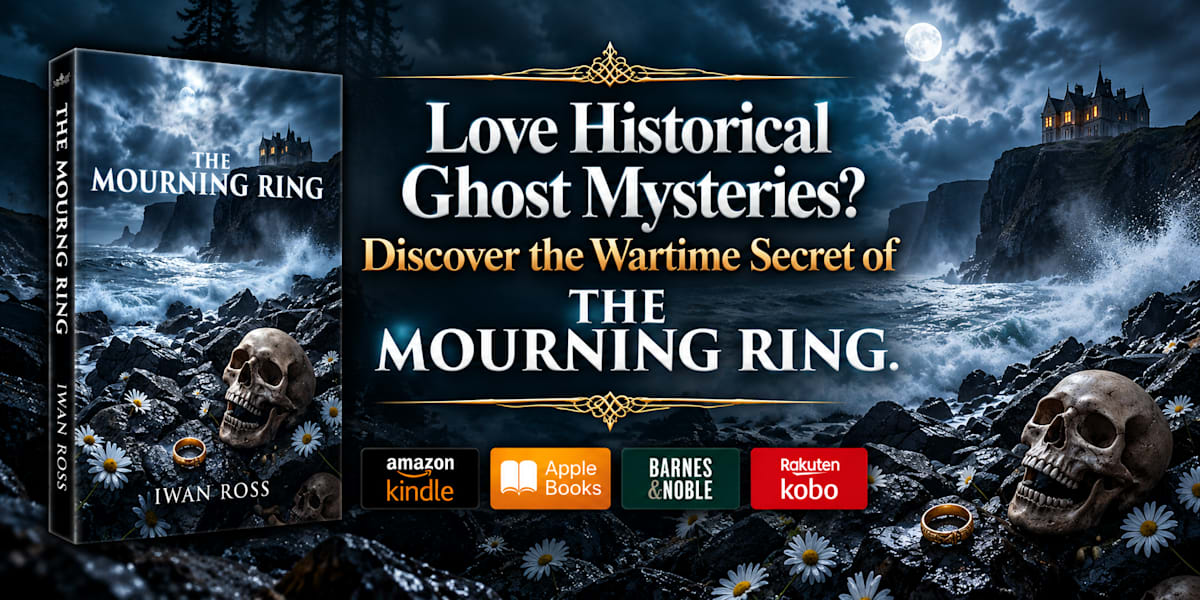
An ancient Scottish manor. A woman who died in 1945. A gold ring containing a message that never reached its destination. And a secret that refuses to remain buried.
Some secrets disappear with the people who carry them.
Others survive for generations, waiting for someone to uncover the truth.
In the Scottish Highlands, where centuries of history linger among ruined castles, lonely graveyards and imposing country estates, the past can sometimes feel remarkably close.
But what if the past could reach into the present?
What if a woman who died eighty years ago still had something important to say?
And what if the answer lay inside an ordinary-looking piece of jewellery?
For readers who enjoy historical ghost mysteries, Scottish Gothic fiction and supernatural suspense, The Mourning Ring by Iwan Ross explores a haunting mystery in which wartime tragedy, hidden messages and restless spirits converge.
A secret carried through the darkness of 1945
The story begins on Midsummer Eve in 1945.
The Scottish Highlands are shrouded in darkness.
Wartime restrictions have extinguished the lights along a lonely coastal road, and the sea crashes against the cliffs beneath an imposing manor.
A woman named Daisy is running for her life.
Above her, military aircraft make their way through the night sky.
Something has gone terribly wrong.
A warning has failed to reach its destination, and Daisy carries a message that may hold the key to understanding what happened.
The message is concealed inside a small gold ring.
But before she can deliver it, tragedy intervenes.
The ring survives.
Its secret remains unread.
And the woman who carried it becomes part of a history that refuses to disappear.
When a piece of jewellery holds a forgotten story
Jewellery has long held a special place in Gothic fiction.
An old locket might contain a portrait of someone forgotten.
A necklace may connect generations of a family.
A ring can represent love, loyalty, grief or a promise that survives death.
In The Mourning Ring, a small gold ring becomes something more.
It is a vessel for a message.
A physical connection between the living and the dead.
And a reminder that even the smallest object can carry the weight of an extraordinary history.
The mystery is not simply about discovering what the ring contains.
It is also about understanding why its message matters, who was meant to receive it, and what might have happened if the truth had emerged decades earlier.
For readers drawn to historical mysteries involving hidden letters, family heirlooms and forgotten wartime events, this is a story in which the past remains unfinished.
A Scottish Gothic mystery spanning generations
Eighty years after the events of 1945, the world has changed beyond recognition.
But some places seem almost untouched by time.
Ancient manor houses still stand behind imposing gates.
Old corridors echo with memories.
And forgotten rooms conceal evidence of lives that ended long ago.
The McTavish family finds itself drawn into another mystery connected to Serpent's Manor, an imposing Scottish estate with a troubled history.
Coby McTavish is no stranger to the supernatural.
His experiences with restless spirits have taught him that the dead sometimes have unfinished business.
But the mystery surrounding Daisy and the mourning ring brings him face to face with something more than an unexplained haunting.
It is a story of wartime decisions, lost opportunities and a truth that has waited far too long to be understood.
The woman who refuses to be forgotten
Ghost stories often begin with fear.
A strange sound in an empty room.
Footsteps where nobody is walking.
A figure glimpsed in the shadows.
But some of the most affecting supernatural mysteries ask a different question.
What if the ghost is not trying to frighten anyone?
What if she is trying to be heard?
Daisy's story introduces the possibility that a haunting may be an expression of unfinished grief, an undelivered warning or a promise that death interrupted.
Her connection to the ring reaches beyond the circumstances of her death.
It raises questions about memory, responsibility and the people left behind.
And it reminds us that history is not only a collection of dates and events.
It is also made up of individual lives, private hopes and moments that changed everything.
The shadows of the Second World War
The Second World War provides a haunting historical backdrop for the mystery.
Its atmosphere of secrecy, uncertainty and danger becomes an essential part of Daisy's story.
Communications can fail.
Information can be misunderstood.
Trust can be misplaced.
And a decision made in a moment of confusion may have consequences that endure for decades.
The novel's wartime storyline is fictional, but it draws upon the kinds of moral dilemmas that make historical suspense so compelling.
Who can be trusted when information is incomplete?
What happens when a warning arrives too