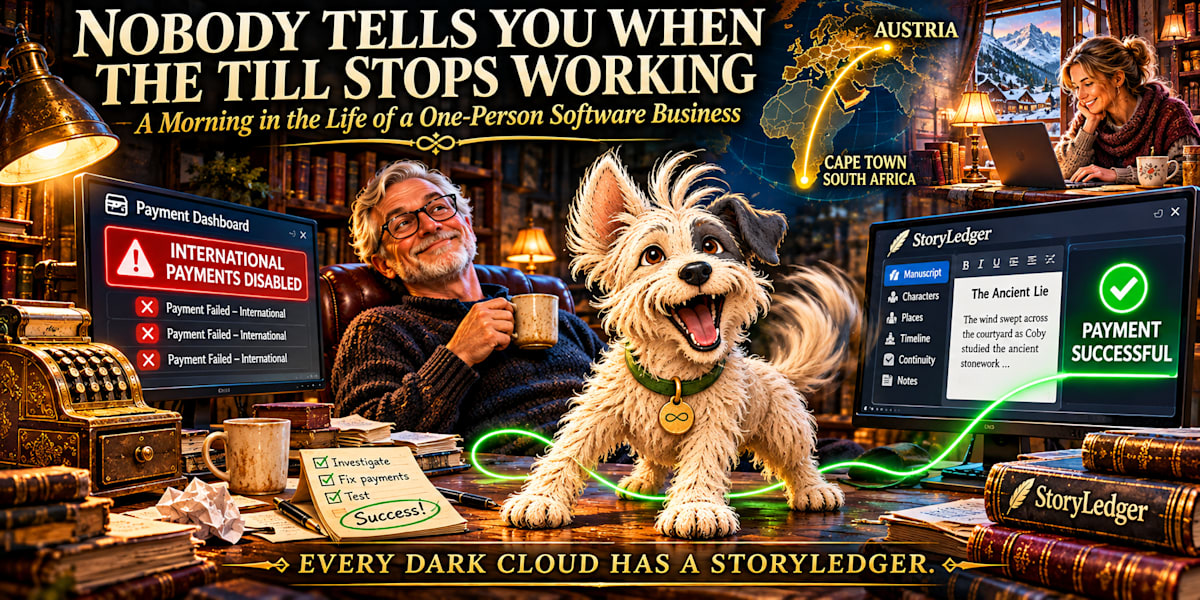
A morning in the life of a one-person software business
Yesterday I logged into my payment dashboard for no particular reason. Something had nagged at me — the sort of itch you get when a thing has been too quiet for too long.
What I found was a list of failed payments. Not two or three. Hundreds.
My first thought was that I had somehow been very popular and very unlucky at the same time. My second thought, once I had read a few rows, was closer to the truth: almost all of them were automated card testing. Someone with a list of card numbers had been using my checkout page to find out which ones still worked. The names did not match the email addresses. A third of the phone numbers could not physically be dialled — area codes beginning with zero, which no telephone exchange on earth will accept. Sixty-five of them had arrived inside the same minute.
That was unpleasant but not, in itself, the problem.
The problem was a message sitting against a handful of the others:
Merchant is not enabled for international transactions.
The quiet part
I went looking for the setting. I found it. I switched it on. It did not switch on.
So I wrote to support, and got a straight answer back: international card payments had been restricted on my account after automated card attempts were detected on it, and they were unable to offer international payments to businesses with limited payment history. The restriction would stay.
I want to be fair here. Card testing is a genuine problem and a processor that ignored it would be worse than one that overreacts. Their reasoning is defensible.
But nobody told me. No email, no dashboard banner, no note on the account. A decision was taken that closed my shop to everyone outside South Africa, and I found out because I happened to be curious on a Thursday morning.
I write Gothic mysteries. I also develop StoryLedger, a desktop writing and continuity management application designed to help fiction authors manage their manuscripts, characters, timelines and increasingly complicated fictional worlds. My customers are in Ohio and Yorkshire and Lower Austria. "Local cards still work" is not a consolation; it is a description of a business with no customers.
And then the email that actually mattered
That same evening, a writer in Austria wrote to me. She had been using the free trial for a week. She wanted to buy. The card had refused her, she had tried the two other payment options and found they were not available in her country, and she wanted to know whether she could send the money by PayPal instead.
She had done everything right. She had found the software by herself, tested it against about twenty other tools, decided mine was the one, and arrived at the till with money in her hand — and the till said no, in a way that made it sound like her fault.
She is the only one who wrote.
That is the number I keep turning over. One person out of however many hit that wall took the trouble to find my email address and tell me. The rest closed the tab. I will never know who they were, what they were writing, or whether they went and bought something else.
What I did about it
Moved, the same day. The new checkout is on Gumroad, which takes cards from anywhere, offers PayPal, and — a detail I had not thought about until I had to — acts as merchant of record, so it collects and pays over VAT in the countries that charge it on software. For a sole trader in Cape Town selling to the European Union, that last part is not a convenience. It is the difference between a side business and a tax problem.
It costs more. Roughly fifteen per cent by the time card processing is added, against the much thinner slice I was paying before. I will take fifteen per cent of something over nothing per cent of nobody.
I also stopped pricing in rand. The price was R499 with a dollar figure in brackets, which asked every overseas buyer to do arithmetic before deciding. It is now simply $39, one payment, yours to keep.
By that evening the writer in Austria had bought her licence.
Five things I would tell another author selling anything
Look at your failures, not your sales. Your dashboard is built to show you what worked. The interesting information is in what did not, and nobody puts that on the front page.
Assume no one will tell you when buying breaks. Not your processor, and not your customers. Broken checkouts do not generate complaints. They generate silence, which looks exactly like not being popular yet.
Make it absurdly easy to reach you. The only reason I learned how bad this was, as fast as I did, was that one reader could find an email address and believed a human would answer it. That is worth more than any analytics dashboard.
Treat the one person who writes as a hundred who did not. She was not an edge case. She was the only one willing to do my quality assurance for me, for free, out of goodwill.
Check where your confirmation emails actually go. A separate lesson from the same week: a reader never received her licence key because her receipt went to the address she had paid with, and she reads her mail somewhere else entirely. The key had been sent a month earlier. Now my thank-you page says, in as many words, check that the address you paid with is one you actually read.
The silver lining
It was a bad morning that turned into a good one. The checkout works everywhere now, the price is honest, the receipt tells people what happens next, and the writer in Austria has her licence key.
And I know something I did not know on Wednesday: that somebody can discover StoryLedger without any help from me, compare it against twenty other writing applications, and choose it.
For an independent novelist who originally developed the software to solve problems in his own fictional universe, that is a rather extraordinary thing to discover.
That is worth more than the morning cost.
About StoryLedger
Developed by independent novelist Iwan Ross, StoryLedger helps fiction authors organise their fictional worlds, manage characters and timelines, identify continuity issues and export comprehensive story bibles.
Available with a free 30-day trial and a one-time licence purchase of $39. No recurring subscription.