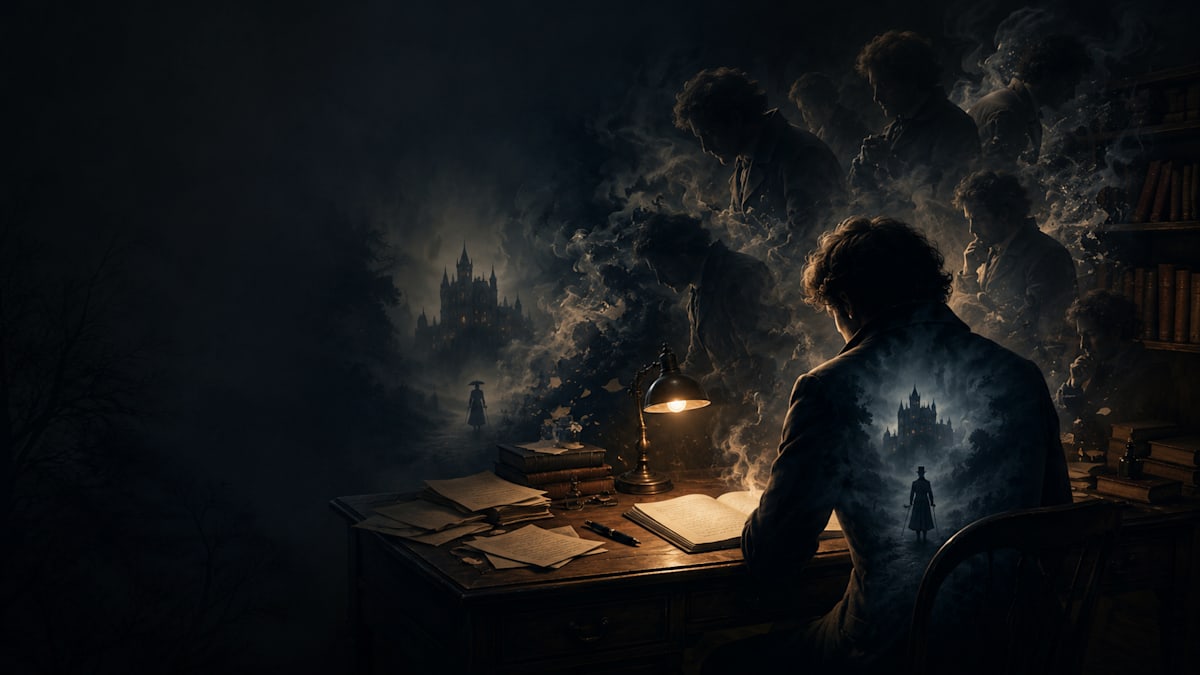
There is a peculiar moment in writing that I have only recently learned how to recognise.
I call it Absent Presence.
I doubt the term will trouble the great halls of literary academia anytime soon. I made it up. But then, inventing things that do not exist and subsequently behaving as though they do is rather fundamental to my profession.
Absent Presence is the strange condition of having everything required to write — imagination, experience, characters, story, vocabulary and, somewhere beneath the rubble, confidence — while suddenly feeling as though none of it is there.
The writer has not disappeared.
Yet somehow, the writer feels absent.
When Writing Becomes a Committee Meeting
Perhaps one of the cruellest ironies of becoming a better writer is that improvement does not always feel like improvement.
When we begin, we often write instinctively. We don't know enough to interrogate every sentence. We simply tell the story.
Then we learn.
We learn about structure, pacing, point of view, repetition, rhythm, filtering, exposition, dialogue tags, beats, character arcs and a small army of other things apparently waiting to ambush an unsuspecting adjective.
We read more critically. We become more observant. Editors teach us things. Readers teach us things. Other writers teach us things.
Our critical faculties sharpen.
And then something rather unexpected can happen.
Every sentence suddenly has seventeen possible alternatives.
Something we would once have written without hesitation becomes a decision requiring a committee meeting.
Is this word correct?
Is there a better one?
Will the reader understand the joke?
Is the joke too obvious?
Is it not obvious enough?
Would an editor change this?
Has another author done it better?
Will somebody find this ridiculous?
And somewhere during this increasingly crowded meeting, the person who actually wrote the story quietly leaves the room.
That, to me, is Absent Presence.
The Tailcoat Incident
I recently spent an absurd amount of mental energy worrying about a fictional man's jacket.
The man in question is Lord Giddings, an eccentric Grand Master who sweeps into an intelligence briefing wearing a bowler hat, brandishing an umbrella and sporting a rather magnificent item of bespoke Highland tailoring.
He also tap-dances.
This did not concern me.
The supernatural intelligence organisation did not concern me.
Nor did the fact that his agents applaud his entrance, attempt to decipher an appalling chalk charade, shout “Fiat!” while pumping their fists into the air, and are dismissed immediately after somebody actually responds to the question, “Questions?”
No.
What nearly broke me was the tweed.
Was it a tweed?
A tweed jacket?
A tweed tailcoat?
A tailcoat cut from tweed?
Could tweed stand alone as a noun?
At some point I realised something rather alarming.
I was no longer seeing Lord Giddings.
I was seeing the sentence.
Worse, I was seeing everyone else's possible version of the sentence.
The character was still standing exactly where I had put him, probably wondering why his creator had abandoned him halfway through an intelligence briefing.
He had not disappeared.
I had.
Our Characters Know This Feeling
The curious thing is that writers spend their lives creating characters who experience versions of precisely this phenomenon.
We give them flaws they cannot see.
We let fear convince them they are weak when the reader can plainly see their strength.
We allow grief to make them believe happiness has vanished forever.
We let pride distort their judgement, insecurity silence them, love make fools of them and doubt persuade them that everything they once understood about themselves was wrong.
As writers, we can see what is happening because we stand outside them.
We know the brave character is frightened, not cowardly.
We know the lost character has not ceased to exist.
We know the person convinced they have nothing left is carrying the very thing they need without recognising it.
And then, occasionally, we do exactly the same thing.
There is something wonderfully absurd about spending years understanding imaginary people's blind spots while remaining spectacularly vulnerable to our own.
Is This Writer's Block?
Perhaps sometimes.
I don't believe writer's block is one single phenomenon with one convenient cause. A writer can stop because the story has gone wrong. Because they are exhausted. Because life outside the manuscript has consumed everything available inside them. Because they don't yet know what happens next.
But I wonder whether another kind of block begins when creation becomes observation.
Instead of writing, we watch ourselves writing.
Instead of hearing a character speak, we evaluate the dialogue before the character has finished the sentence.
Instead of following instinct and examining the result afterwards, we demand that instinct defend itself before it is allowed onto the page.
Eventually, writing becomes so heavily supervised that nothing moves without permission.
The imagination has not gone.
It is standing at the security checkpoint waiting for seventeen members of the committee to stamp its passport.
Perhaps some writer's block is not an absence of ideas at all.
Perhaps it is an excess of witnesses.
Not Every Reader Is Your Reader
There is another uncomfortable truth writers eventually have to accept.
Readers are individuals.
One will laugh at a line another reader dislikes.
One will adore the character another cannot tolerate.
One will race through a chapter that another considers slow.
A moment somebody finds moving may strike somebody else as sentimental. A joke that has one reader laughing aloud may leave another staring at the page in profound concern for the author's wellbeing.
We cannot control that.
Nor, increasingly, do I think we should try.
There is an important difference between:
A reader cannot understand what I am trying to communicate.
and:
A reader understands it perfectly and simply doesn't like it.
The first may reveal a problem worth examining.
The second may simply reveal a reader.
If we attempt to anticipate every possible reaction, we eventually write for an imaginary consensus that does not exist.
And the price of pleasing that imaginary reader may be removing the very peculiarities that would have delighted the real one.
Feedback Is Evidence, Not Law
This does not mean rejecting criticism.
Quite the opposite.
A good editor is invaluable. So are perceptive readers. So are the people willing to tell us when something confused them, bored them or pulled them out of the story.
But perhaps feedback works best when treated as evidence rather than instruction.
If someone stumbles over a sentence, I want to know.
But the useful question is not necessarily:
What replacement should I make?
It may be:
Why did they stumble?
Once I understand the problem, I can decide whether something needs changing and, importantly, how I would change it.
Because there is a danger in solving every criticism by accepting somebody else's sentence.
Eventually the manuscript may become technically polished while sounding increasingly unlike the person whose name will appear on its cover.
The Thing Worth Protecting
Technique can be learned.
Sentences can be rewritten.
Plots can be repaired.
Continuity errors can be caught. Facts can be checked. Awkward paragraphs can be untangled.
But voice is stranger.
It grows from thousands of decisions we make without necessarily knowing why: rhythm, humour, observation, what we notice, what we omit, where we pause, what we find beautiful and what we find ridiculous.
It is the accumulation of our peculiarities.
That does not make every instinct correct.
It does make those instincts worth listening to.
Perhaps becoming a better writer is therefore not simply a process of learning more rules.
Perhaps it is learning enough to recognise when a rule helps the story — and becoming confident enough to recognise when it doesn't.
Coming Back Into the Room
I don't have a cure for Absent Presence.
I invented the term this morning, so demanding a treatment already seems rather unreasonable.
But I think I am beginning to recognise the way back.
Sometimes the answer may simply be to stop editing.
Close the comments.
Leave the troublesome sentence alone.
Walk away.
Then return when the committee has gone home.
Look past the words and find the character again.
What was he doing?
What did she want?
What was funny about this before I started explaining why it was funny?
What frightened me?
What delighted me?
What made me want to write this story in the first place?
The writer may feel absent.
But perhaps the writer never actually left.
Perhaps they are still sitting somewhere beneath the criticism, technique, expectations and noise, waiting for the room to become quiet enough to be heard again.
And somewhere in an intelligence briefing room of my own invention, Lord Giddings is still wearing his ridiculous Highland tweed, tapping his umbrella impatiently against the floor.
He has a mission to announce.
I should probably let him get on with it.