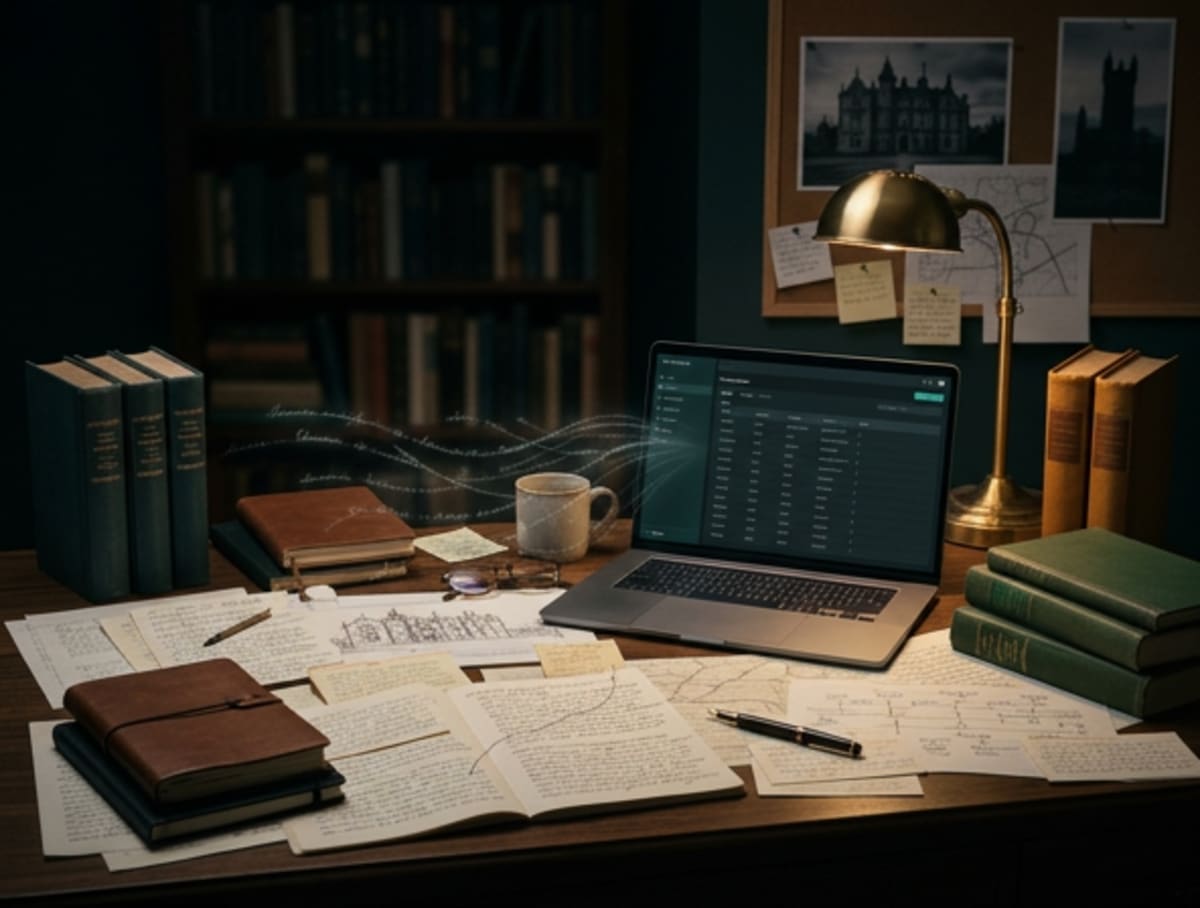
There comes a point when the fictional world inside your head becomes too large to live there comfortably.
For me, that point arrived somewhere around eight books.
It wasn't writer's block. Quite the opposite. I had characters, histories, locations, relationships and storylines stretching across multiple novels and, eventually, three different series.
What I didn't have was a reliable way of remembering all of it.
I had notes. Plenty of them.
I had manuscripts I could search, documents I could reopen and details I was absolutely certain I would remember when I needed them again.
Writers probably know how that last one ends.
The problem with remembering your own world
When I began writing Elm Brook Manor, keeping track of the story wasn't particularly difficult. I knew the characters intimately, the world was relatively contained, and most of what mattered was still fresh in my mind.
Then one book became another.
Characters returned. Relationships changed. Places acquired histories. Small details from earlier novels suddenly mattered again.
And the fictional world kept growing.
The original McTavish stories developed into The Haunted Highlands Series. More recently, The Highlands University of Ghostology grew into something with an identity of its own, and I made the decision to separate it into a new series.
The stories remain connected. In fact, readers who want Coby McTavish's complete journey are still best served by beginning with Elm Brook Manor.
But from a writer's perspective, I was now maintaining a fictional universe spread across eight titles and three series.
And that raises surprisingly mundane questions.
When did I first establish that detail?
What did this character know at this point in the story?
Have I already resolved this thread?
How did I describe this location three books ago?
Was that character present when this happened?
What have I written down somewhere that I have completely forgotten to look for?
None of those questions is especially dramatic.
Getting one of them wrong can be.
I needed something better than another notebook
Eventually, I realised that the problem wasn't a lack of notes.
The problem was the notes themselves.
They were useful when I remembered they existed. Less so when I didn't.
What I wanted was somewhere I could keep track of the moving pieces of a story while still allowing the manuscript to remain the manuscript.
I didn't want software to write my books.
I didn't want it inventing characters for me, deciding what happened next or replacing the judgement that comes from actually knowing your own story.
I simply wanted help keeping track of the story I had already told.
That need eventually became StoryLedger.
Building something I needed myself
StoryLedger began as a tool for my own writing.
That distinction matters to me.
I wasn't sitting down trying to imagine what an author might find useful. I was sitting in front of my own manuscripts encountering problems I was already tired of solving manually.
So I built around those problems.
Story notes needed somewhere to live.
Issues needed to remain visible until I had dealt with them.
Characters, locations and other details needed to be easier to revisit.
And when I returned to a manuscript after working elsewhere, I needed a way to understand where I had been without reconstructing everything from memory.
Over time, the little tool became something much larger.
Eventually I reached the slightly unnerving moment familiar to anyone who makes something:
I had to let somebody else use it.
StoryLedger has left my desk
StoryLedger is now publicly available in release V0.9.4.
And somebody on the other side of the world is already using it.
One of StoryLedger's first active users is in Australia and has been regularly sending me screenshots, observations and feedback while using the application.
Those screenshots are extraordinarily useful.
When you build software yourself, you know what every button is supposed to do. You know why something is positioned where it is. You know the workflow because you invented the workflow.
Another person knows none of that.
They simply use it.
And that is where you begin discovering whether you've actually built something intuitive rather than merely something familiar to its creator.
StoryLedger is already benefiting from that process.
I've also noticed increased traffic to the BlurbCraft Studio website since releasing it. I don't currently collect the sort of telemetry that would allow me to translate that into a download count, so I won't pretend that I can.
But people are looking.
For a newly released independent application, that's encouraging enough for me.
Eight books later
Perhaps the best test of StoryLedger is the reason it exists in the first place.
My fictional world hasn't become simpler.
It has become considerably more complicated.
I now have eight titles spread across three series, characters whose histories extend through multiple books, and a new series that can welcome readers independently while still carrying history from the stories that preceded it.
There will be more books.
There will undoubtedly be more characters.
And, knowing me, there will almost certainly be more ghosts.
StoryLedger doesn't remove that complexity.
It makes the complexity manageable.
It doesn't write the story for me.
It helps me remember the one I've already written.
And if another writer eventually reaches the same point I did—when their fictional world has grown too large for scattered notes, spreadsheets and memory alone—perhaps StoryLedger will help them too.
That would make all the work behind it worthwhile.
StoryLedger Early Release can now be purchased at a discounted rate from BlurbCraft Studio.
https://blurbcraftstudio.com/storyledger.html
And if you'd like to see the fictional universe that helped create it, you can begin where Coby McTavish's journey began:
https://iwanross.com/books/elm-brook-manor
Or explore the newest branch of that world:
https://iwanross.com/series/the-highlands-university-of-ghostology