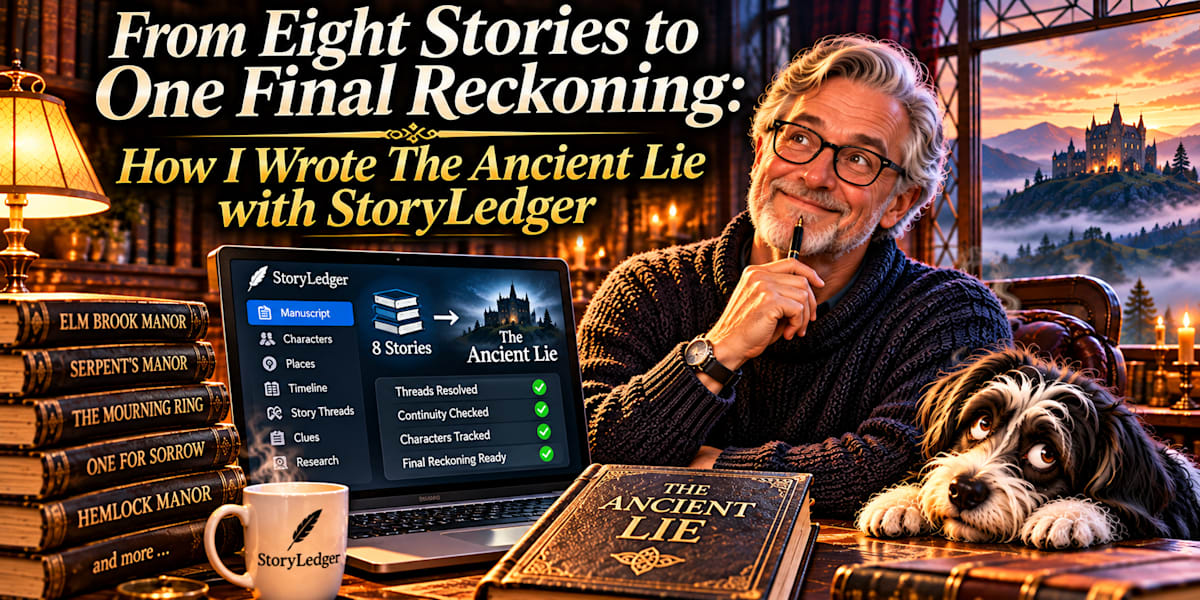
Eight stories. Years of mysteries. One final reckoning.
When I began writing The Ancient Lie, the concluding novel in The Highlands University of Ghostology trilogy, I knew it would be challenging.
What I hadn't fully appreciated was just how far back I would need to travel.
Not merely to Tudor England, where Anne Boleyn, Henry VIII and a forgotten promise would become central to the mystery.
I would also have to travel back through my own books.
All the way to the first pages of Elm Brook Manor.
And there, waiting patiently among the characters, secrets and unfinished business of a story I had written years earlier, were threads that still needed their endings.
Some of them had been waiting through eight stories.
It was time to bring them home.
Writing a Novel That Had Eight Stories Behind It
Every novel presents its own challenges.
Some demand extensive historical research. Others require complicated plotting, careful character development or the management of multiple timelines.
The Ancient Lie demanded all of those things.
It also required something else: continuity across years of storytelling.
By this point, Coby McTavish and the people around him had lived through extraordinary experiences.
Relationships had developed. Families had changed. Characters had appeared, disappeared and returned. Mysteries had been solved, while others had quietly remained open.
And some seemingly insignificant details had acquired new importance.
I couldn't simply write another supernatural mystery and ignore everything that had happened before it.
This was the conclusion of a trilogy, but it also offered an opportunity to bring together unfinished business from the wider Haunted Highlands stories.
That meant going back to the beginning.
The Name Waiting on the First Page of Elm Brook Manor
One of the discoveries that delighted me most involved a name from Elm Brook Manor.
Gordon Snape.
Readers who remember the earliest story may recognise it.
Years later, while working on The Ancient Lie, I found myself returning to that name and the circumstances surrounding it.
What had once seemed like a small detail now had a place in a much larger mystery.
And Gordon Snape wasn't alone.
There was Josephine.
There was Giles.
There was the history of Elm Brook Manor itself, including its former owners and the events that had left such a lasting mark on the estate.
There was an old murder investigation and the complicated legacy of the Lucas family.
Even John Drake, an acquaintance from Coby's earlier adventures in Paris, had another part to play.
These weren't simply names to mention in passing.
They belonged to a fictional world with its own history, and I wanted that history to matter.
I wanted readers who had followed Coby from the beginning to experience the satisfaction of discovering that those earlier stories had not been forgotten.
But I also needed to make sure that every connection made sense.
And that was where the real work began.
How StoryLedger Helped Me Track the Continuity of Eight Stories
Thankfully, by the time I started bringing The Ancient Lie together, I had completed a project of my own.
StoryLedger.
I had developed StoryLedger as a writing tool to help fiction authors organise the increasingly complicated worlds they create.
And now I was about to give it a rather demanding assignment.
I already had a comprehensive Story Bible containing information from my earlier novels.
My characters, places, timeline events, research and story threads were organised and available.
Instead of searching through multiple manuscripts and trying to remember where something had happened, I could return to the relevant records and follow the connections.
Who had appeared in which story?
What had happened to them?
Which mysteries had been resolved?
Which threads were still open?
What details had I established years earlier that I absolutely must not contradict now?
For a standalone novel, these questions can be difficult enough.
For a story connected to eight earlier books, they can become a considerable challenge.
StoryLedger gave me a way to manage that complexity.
And because I had created the software myself, I was finally using it for exactly the kind of writing problem that had inspired its development.
There was something immensely satisfying about that.
The Story Bible Became My Map
I have always believed that characters should have lives beyond the immediate events of a novel.
Their experiences matter.
Their relationships matter.
And their past should influence the decisions they make in the present.
But the more stories you write, the harder it becomes to keep track of everything.
In The Ancient Lie, I needed to revisit events from Elm Brook Manor, follow developments through the Haunted Highlands stories and return to clues planted in The Highlands University of Ghostology.
Some threads had been left deliberately unresolved.
Others had simply remained part of the larger history of the characters.
Now they needed to fit into one coherent conclusion.
My StoryLedger records allowed me to examine those threads alongside character histories, locations and timeline events.
The roadmap for The Ancient Lie was taking shape.
I could see how the different mysteries might connect.
And perhaps most importantly, I could distinguish between what I had already established in an earlier book and what I was free to invent for the new one.
A fictional world needs rules, even when that world is populated by ghosts.
Especially when it's populated by ghosts.
Tudor History Added an Entirely New Challenge
Of course, untangling my own fictional history was only half the battle.
The Ancient Lie also required a tremendous amount of historical research.
Anne Boleyn's life, her relationship with Henry VIII, the allegations surrounding her earlier attachment to Henry Percy, the Tudor court, and the historical settings of England and France all became important parts of the creative process.
Then there was Hampton Court Palace.
Its architecture, royal history and famous ghost legends offered an extraordinary setting for a supernatural mystery.
But I didn't want Tudor history to become mere decoration.
I wanted the historical questions to help drive the story.
What might an old promise mean in a world where the dead can return?
What happens when the past refuses to accept the verdict of history?
And what if a king who once wielded absolute power discovers that death has not made everyone more obedient?
The research was fascinating.
It was also exhausting.
There were times when I felt I was investigating two separate histories simultaneously: the Tudor past and the fictional past I had created across my novels.
Fortunately, I had somewhere to keep the information organised.
The Clues I Had Left for Myself
One of the most enjoyable parts of writing The Ancient Lie was returning to The Highlands University of Ghostology.
I had left clues and unresolved threads there for the final novel.
Now I needed to find them again, examine how they related to the developing plot, and decide how best to bring them together.
The challenge was not simply remembering the clues.
It was ensuring that their eventual resolutions felt earned.
A revelation should make readers think back to something they encountered earlier.
Perhaps a name.
Perhaps a conversation.
Perhaps an incident that seemed relatively unimportant at the time.
And then, suddenly, it matters.
That is one of the great pleasures of reading a mystery.
It is also one of the great pleasures of writing one.
But achieving it across several novels requires care.
I spent a great deal of time reviewing character relationships, revisiting earlier events and checking the chronology.
I wanted the final story to reward readers who had travelled this far with Coby and Gracie.
I also wanted to avoid the kind of continuity errors that can quietly undermine a carefully constructed mystery.
Writing Software Doesn't Write the Novel
There's something important I should say about StoryLedger.
It didn't invent the plot.
It didn't create the characters.
It didn't decide what happened to Josephine, how the Tudor mystery would unfold, or what Coby and Gracie would face.
Those were my decisions as the author.
What StoryLedger did was help me organise the information I needed to make those decisions.
It gave me a way to revisit earlier stories, keep track of complicated relationships and maintain a clearer view of the fictional world I was working in.
And that freed me to concentrate on the part I enjoy most.
Telling the story.
I think that's what good writing software should do.
It shouldn't replace the writer's imagination.
It should make that imagination easier to manage.
For me, The Ancient Lie became the ultimate test of that principle.
Bringing the McTavish Mysteries Full Circle
As the manuscript developed, I began to experience a feeling that is difficult to describe.
Satisfaction, certainly.
Relief, occasionally.
And more than a little astonishment.
Characters and events from years earlier were finding their places in a new story.
Old mysteries were acquiring their final significance.
And the world that began with Elm Brook Manor was coming together in ways I found deeply rewarding.
Some of the most emotional moments in The Ancient Lie have nothing to do with Henry VIII or Anne Boleyn.
They concern the people who have lived with the consequences of events stretching back through the earlier books.
Those are the moments I particularly wanted to get right.
Because however extraordinary the supernatural events become, the characters remain the heart of the story.
Coby and Gracie have travelled a long road.
So have I.
The Most Challenging Story I've Written
Looking back, The Ancient Lie stands among the most challenging novels I have written.
It required extensive research, careful planning and a great deal of patience.
I had to manage multiple mysteries, revisit years of character history and ensure that the conclusion honoured what had come before.
There were moments when I wondered whether I had made the task unnecessarily difficult for myself.
Quite possibly.
But I wouldn't have wanted to tell the story any other way.
And there was a particular satisfaction in knowing that StoryLedger, the writing software I had spent so much time developing, had become an integral part of the process.
The author and the software developer had finally found themselves working on the same problem.
For once, they even agreed on the solution.
Two Projects, One Story
Today, I'm delighted to share both the novel and the tool that helped me organise its complicated fictional world.
The Ancient Lie is the concluding book in The Highlands University of Ghostology trilogy.
It's a darkly comic Scottish ghost mystery involving Anne Boleyn, Henry VIII, haunted palaces, forgotten promises and the return of unfinished business from the Haunted Highlands.
The novel is scheduled for publication on 15 December 2026.
Discover The Ancient Lie and choose your preferred bookseller:
https://iwanross.com/books/the-ancient-lie
StoryLedger is my desktop writing tool for fiction authors who want to organise characters, relationships, timelines, places, research and story threads, and build a Story Bible for their novels.
If you've ever struggled to remember what happened three chapters ago — or three books ago — you'll understand why I created it.
Explore StoryLedger and its 30-day trial:
https://blurbcraftstudio.com/storyledger.html
And if you're curious about where Coby McTavish's extraordinary journey began, you can discover Elm Brook Manor, the first Haunted Highlands story.
https://iwanross.com/books/elm-brook-manor
Eight stories. Years of mysteries. One final reckoning.
And for this author, one extraordinarily satisfying journey.