Sometimes the most important discovery isn't hidden in a manuscript. It's hiding in your book metadata.
Yesterday, I sat down to review my books.
Nothing particularly exciting about that, you might think.
A little housekeeping. A few prices to check. Some keywords, categories and descriptions that might need attention.
The usual administrative work that comes with being an independent author.
By the time I finished, however, I had discovered something rather embarrassing.
I HAD SIX NOVELS. BUT NO SIX-BOOK BOX SET.
Good heavens.
How had I managed that?
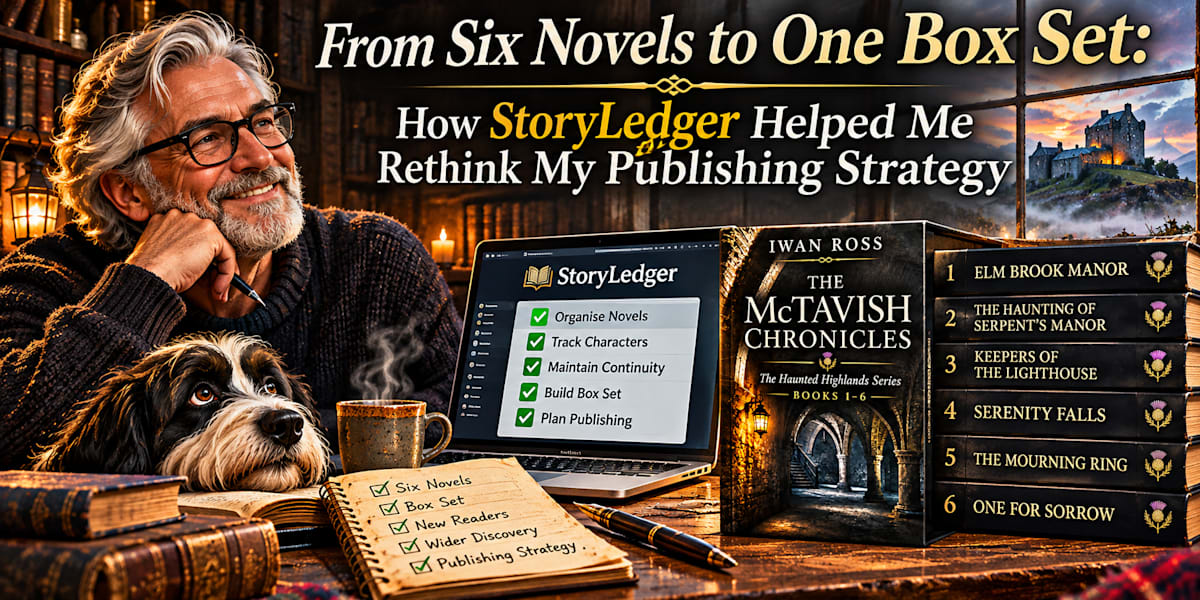
Within a day, The McTavish Chronicles: The Haunted Highlands Series, Books 1–6 was born.
A new ebook collection, a new cover, a cinematic trailer and another opportunity for readers to discover Coby McTavish's adventures.
But the interesting part of this story isn't the box set.
It's what led me to create it.
Publishing a Book Is Rather Like Driving a Formula One Car
Bear with me.
A Formula One driver doesn't climb into a racing car, press the accelerator and hope for the best.
There are countless variables to consider.
Tyre pressure. Fuel loads. Aerodynamics. Track conditions. Engine settings.
A small adjustment here, another there, and suddenly the car performs differently.
Publishing books isn't entirely unlike that.
Consider the variables an independent author must manage.
Book titles and subtitles. Keywords and BISAC categories. Descriptions and cover designs. Ebook, paperback and hardcover formats. Pricing, collections, retailer requirements and promotional opportunities.
And that's before we begin examining sales.
Platforms such as Amazon KDP and Draft2Digital allow authors to revisit many of these decisions.
A description can be improved. A cover can be updated. A price can be tested. Keywords and categories can be reviewed.
And every change raises the same question.
Did it make a difference?
That's where things become interesting.
Tweak. Adjust. Test. Repeat.
Imagine managing a single novel.
You review its description, change a few keywords and adjust the price.
A month later, you examine the results.
Did sales improve? Did they decline? Was the change worthwhile?
Now imagine managing ten books.
Or twenty.
Or an entire series, with multiple formats, editions and collections.
Suddenly, remembering what you changed, when you changed it and why becomes rather important.
Because without that history, you're not necessarily learning from your experiments.
You might simply be repeating them.
Tweak. Adjust. Test.
Eat. Sleep. Repeat.
Pray a little.
And perhaps, one glorious morning, discover that something actually worked.
Then you have another problem.
Can you remember exactly what you did?
The Idea Behind StoryLedger's Publishing Dashboard
This is one of the reasons I've been developing the Publishing section of StoryLedger, my desktop application for fiction authors.
StoryLedger began as a way to organise the complicated business of writing fiction.
Characters, relationships, timelines, story threads, clues and continuity.
But completing a manuscript is only part of an author's journey.
Eventually, the book must find its readers.
And that's where publishing metadata becomes important.
StoryLedger already provides a place to organise book details and publishing information, including retailer rules, metadata and the records authors need to manage their titles.
The larger publishing dashboard I'm developing goes considerably further.
My goal is to give authors a clearer picture of how their books perform over time, alongside the publishing decisions they've made.
Imagine being able to review a title's pricing history, descriptions, keywords, categories and cover versions, then compare those records with its sales performance.
Not merely to see whether a book sold.
But to begin understanding what happened around the time its performance changed.
Perhaps a new cover coincided with increased sales.
Perhaps a pricing adjustment was followed by fewer purchases.
Perhaps a particular description performed better than its predecessor.
The dashboard would help authors identify those patterns through visual comparisons and historical records.
Of course, a change in sales doesn't automatically prove that a particular adjustment caused it. Promotions, seasons, retailer visibility and other factors can influence the results.
But having the information organised in one place would give authors a far better starting point for making informed decisions.
That's the goal: less guesswork, better records and more useful insight.
The expanded publishing and performance-tracking features are still in development and beta testing. I'm refining them as I work through my own publishing decisions.
And yesterday provided a rather useful example of why I want them.
The Day I Discovered My Missing Box Set
I was reviewing the pricing and metadata across my published titles.
My intention was straightforward.
I wanted a more consistent pricing structure across Amazon and Draft2Digital, while making it easier for readers to continue through my books.
The first novel in The Haunted Highlands Series, Elm Brook Manor, serves as a free introduction.
Readers who enjoy it can purchase the subsequent novels individually.
But as I examined the numbers, something became obvious.
A reader who wanted to continue through all six books faced several separate purchasing decisions.
And I already had two smaller collections.
Volume One contained Books 1–3.
Volume Two contained Books 4–6.
Then came the rather obvious question.
Why wasn't there a collection containing all six?
I stared at the screen.
Good grief.
I'd been so busy writing, publishing and promoting individual novels that I'd overlooked an opportunity sitting directly in front of me.
So I did something about it.
Introducing The McTavish Chronicles
Within a day, I had assembled a new ebook collection.
The McTavish Chronicles: The Haunted Highlands Series, Books 1–6.
Six complete Gothic ghost mysteries following Coby McTavish through haunted Scottish manors, lonely islands, forgotten secrets and encounters with the dead.
I created a new cover featuring ancient stone arches, cold blue shadows and a glowing amber lantern.
Then came a short cinematic trailer.
And finally, a new book page where readers could discover the collection and choose their preferred retailer.
The pricing decision was equally deliberate.
Readers can purchase the individual novels, but the complete six-book collection offers another option at $9.99.
A simpler way to continue the journey, and a substantial saving compared with purchasing the remaining five novels separately.
Will it work?
I don't know yet.
That's the whole point of testing.
But at least I've created an opportunity that didn't exist the day before.
And I've given myself another publishing decision worth recording and evaluating.
What I Want StoryLedger to Become
I don't believe software can guarantee an author a bestseller.
Nor do I believe there's a magical combination of keywords, categories, covers and prices that works for every book.
Readers are wonderfully unpredictable.
But I do believe authors deserve tools that help them understand their own publishing businesses.
Tools that remember the details.
Tools that preserve the history behind their decisions.
Tools that help them compare results, recognise patterns and avoid making the same mistakes repeatedly.
That's what I want StoryLedger's publishing dashboard to become.
A long-term companion for authors who want to approach publishing with the same care they devote to writing.
Not simply a place to store information.
A place to learn from it.
And if the dashboard eventually helps another author notice an overlooked opportunity, just as I discovered my missing box set, I'll consider that a worthwhile achievement.
Six Books, One New Beginning
For now, The McTavish Chronicles is out in the world.
Its cover is finished. Its trailer has been published. And readers can discover six haunting mysteries in one ebook collection.
As for StoryLedger, the work continues.
There are features to refine, tests to complete and plenty of ideas waiting to be explored.
And I suspect I'll be spending many more evenings reviewing publishing data.
Tweak. Adjust. Test.
Eat. Sleep. Repeat.
Until one day, perhaps, I discover that elusive sweet spot.
Or, as I rather cheekily called it, a title's G-spot.
Good heavens.
I really must get out more.
Discover The McTavish Chronicles
Six haunting mysteries. One unforgettable journey.
https://iwanross.com/books/the-mctavish-chronicles-the-haunted-highlands-series-books-1-6
Explore StoryLedger
A desktop application for fiction authors, designed to help organise stories, characters, timelines, continuity and the publishing journey.