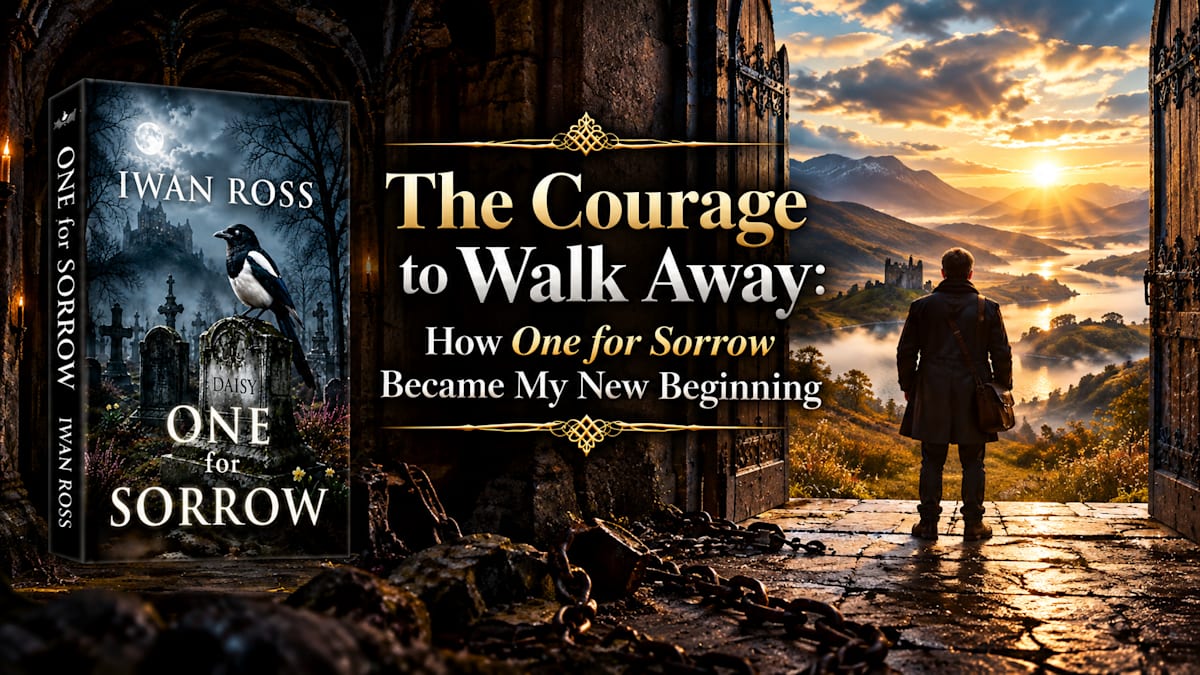
Sometimes the greatest turning point in an author's life happens long before the first word of a new book is written.
There are books we write because we have a story to tell.
And then there are books that become inseparable from the circumstances in which we wrote them.
For me, One for Sorrow belongs firmly in the second category.
It was the sixth and final book in The McTavish Chronicles as readers had come to know the series. It brought a familiar chapter of Coby McTavish's adventures to a close, and I wanted to give those characters, and the readers who had followed them, something memorable.
But there was another reason this book meant so much to me.
It was the first novel I wrote after walking away from corporate life.
And for the first time in years, I could breathe.
Walking Away at the Height of My Career
Before becoming a full-time author, I worked as a lead technical writer.
On paper, I had reached the height of my career. I had spent years developing my skills, building experience and doing what was expected of me.
But professional achievement and personal happiness are not necessarily the same thing.
For a long time, I had felt that I didn't belong in the corporate world.
It was an environment I found increasingly miserable and painful. The emotional toll was considerable, and during my years in corporate employment, I found myself seeking help at recovery clinics on no fewer than four occasions.
Those experiences left their mark.
Eventually, I had to confront a difficult question.
What was the point of holding on to a successful career if the life surrounding it was making me so unhappy?
Resigning was not an easy decision.
Walking away from something you have spent years building takes courage, especially when you have no guarantees about what comes next.
But I knew something had to change.
And when I finally made that decision, I discovered a freedom I had craved for years.
Writing Without the Weight of Corporate Life
One for Sorrow was the first book to benefit from that freedom.
There were no corporate deadlines hanging over my head. No exhausting professional obligations competing with the stories I wanted to tell. No feeling that my creative life had to survive on whatever energy remained after everything else had taken its share.
I could simply write.
And goodness, what a difference that made.
I could lose myself in Serpent's Manor, follow Coby McTavish into another mystery, and allow the story to unfold without constantly watching the clock.
I could experiment, take chances and give the characters the attention they deserved.
I believe that freedom found its way onto the pages.
One for Sorrow became a story I was enormously proud of, not only because of what happened within its fictional world, but because of what writing it represented in my own.
I had finally given myself permission to pursue the life I wanted.
An Unexpected Invitation from The Strand Magazine
Then something rather extraordinary happened.
Before the novel's release, I received an approach from The Strand Magazine.
They wanted to know whether I would be interested in taking half a page to promote One for Sorrow.
I could scarcely believe it.
Here was a magazine associated with some of the biggest names in crime and mystery fiction, including writers such as Lee Child, reaching out about my little Gothic mystery.
Unfortunately, my launch budget simply couldn't accommodate the advertising opportunity.
I declined.
And yes, I still feel a little sad about that.
But the conversation didn't end there.
The magazine requested a proof copy of One for Sorrow, explaining that they would share it with their editors for review and possible consideration for an article.
I had no guarantee that anything further would come of it.
But the request itself meant a great deal.
For the first time, I felt my work had attracted attention in a literary world I had admired from afar.
And for an independent author who had recently left an established career to pursue writing, that was an extraordinary feeling.
A Rather Wonderful Coincidence
Not long after the novel's release, we were watching a Netflix series.
In the story, an author had appeared in The Strand Magazine.
I remember the moment vividly.
There we were, watching a fictional writer celebrate something connected to the very publication that had recently contacted me.
It felt almost surreal.
I couldn't help smiling.
Life has a peculiar way of offering these little coincidences when we least expect them.
And sitting there, thinking about everything that had happened since my resignation, I felt something I hadn't experienced for a very