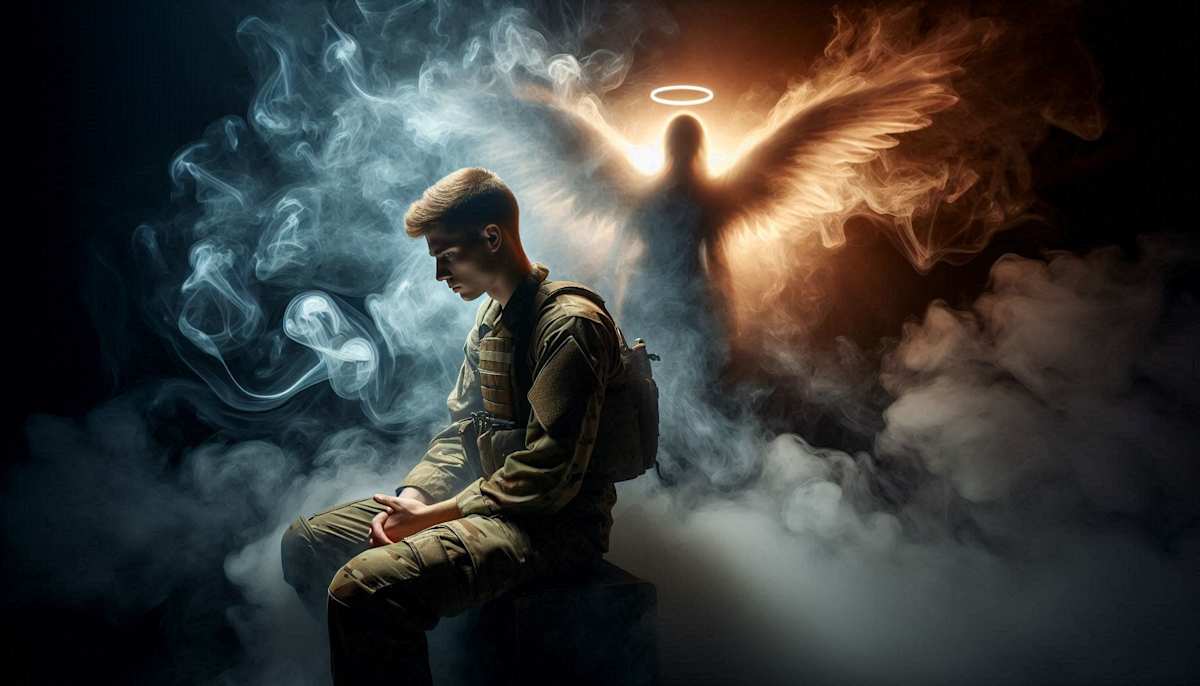
Shortly after seeing the “angelic” figures at the foot of my bed, I drifted into a deep, peaceful sleep. It felt as though only a minute or two had passed when the military base siren wailed, tearing us from our dreams.
We jolted upright on instinct, listening to the pattern, recognising from its relentless cry that it was time to move. Armour vests, uniforms, boots — we pulled them on while already running, converging on the command centre. The top brass took the stage, moustaches bouncing as they barked orders. We braced ourselves for a different kind of conflict.
My assignment was clear. I sprinted for the “bulldog”, a formidable armoured vehicle built for protection and punishment. A six‑wheeler that could eat rough terrain without slowing. I climbed the ladder, slipped through the top hatch, and dropped into the driver’s seat. Eight troopers filed into the rear compartment, their seats arranged in two rows, facing away from me, separated by thick glass panels that allowed them to see out — but not in. The whole machine sealed shut like a tin can.
I pulled the levers, locking us in. The diesel engine roared to life.
Voices crackled over the radio.
“I read you loud and clear, November Eight. Over and out.”
I picked up the handset to address the men behind me, in what we called the bread tin.
“Strap in. This is going to be a rough ride.”
We tore out of the base, merging with a convoy of police and military vehicles flooding onto the highway. Helicopters thudded overhead, their noise swallowed by the constant chatter of radios. We had seen action before, in Mozambique, but this was different.
Rush‑hour traffic was forced aside as we raced out of Pretoria toward Johannesburg and beyond. The beast climbed to its top speed — 110 kilometres an hour — tyres screaming against the asphalt.
“November Eight, position.”
My eyes snapped to a road sign.
“Fifteen minutes out,” I shouted above the engine.
Behind me came the unmistakable sound of rifles being readied. Magazines clicked into place.
A chill ran through me.
This was real.
Then it appeared — a vast black cloud churning into the morning sky, swallowing the sun.
“Oh God,” I whispered, leaning forward as my heart hammered against my ribs.
“November Eight, position — we need help, man!” the radio crackled.
“Five minutes,” I replied, my voice stripped of its earlier confidence.
In the rear‑view mirror I saw it — more military vehicles than I could count. Above us, helicopters swarmed like a disturbed hive.
Training took over. Fear never had time to bloom.
I pressed harder on the accelerator.
A sign flashed past.
Soweto.
My stomach dropped.
This is it, my mind screamed.
Calling it carnage would insult the word itself.
This was political unrest at its most brutal.
For the first time in my life, I condemned myself for joining the army — for enlisting just as Nelson Mandela was released from prison. Before that, I had been offered a chance to attend an Ivy League university.
I joined for two reasons.
It was the final year of compulsory service, and I wanted the experience — to one day write stories like this, to understand what lived between the lines of books like Lane Flint’s.
And I wanted to grow up first, before risking failure at university and losing an opportunity like that.
Until that moment, I believed I had chosen correctly.
Not then.
Never then.
The protesters had chosen their ground well.
“We want the world to see this.”
And the world did.
A high‑traffic artery where highways converged — choking the flow into Johannesburg and Pretoria — right beside the heart of Soweto.
Cars lay overturned like broken toys. Bloodied passengers staggered across the road, desperate to escape. Bodies were scattered as far as I could see. Trucks, buses, cars — everything burned.
People ran while on fire.
Some collapsed mid‑stride.
Others hurled themselves from the overpass, choosing gravity over flame, falling like wounded birds.
Bile rose in my throat. I swallowed it down.
Ahead, a barricade blocked the road.
We were trapped.
“Clever bastards,” I muttered.
The smoke hid them from the air. We were sealed in, visible, helpless.
Sardines in a tin.
Waiting to be cooked.
People fighting for their freedom changes you forever. I spare you the worst of it.
There was no time to release the rear latches for the troopers to return fire. This was Africa — a war zone — and they came with bricks, stones, cans. Anything they could lift.
The impacts thundered against the hull.
Gunfire cracked.
The bulletproof glass buckled, spider‑webbing under the assault.
I did not yet know this was where the Angel of Death had chosen to begin his harvest — collecting lives as though they had become obsolete.
Please forgive the dark humour.
It is how one survives memory.
I had two choices.
Pull the levers and die.
Or stay sealed inside the tin.
I stayed.
Though I prayed for a third option — a clean, merciful ending.
“You guys okay back there?” I shouted.
Screams answered me.
Then the petrol bombs came.
Glass shattered. Fire bloomed. The world turned orange.
Heat slammed into the vehicle. Sweat soaked my uniform in seconds. Flames clawed at the windows.
The troopers’ screams will never leave me.
We were cooking.
I reached for the levers.
They burned me.
I collapsed back, eyes closing.
Eighteen years old.
That was all the world had given me.
Then — silence.
Unnatural. Sudden.
I opened my eyes.
The flames were dying.
With my rifle I forced the hatch open and climbed out.
Everywhere — people running. Young. Old. Fleeing over the hills, trampling each other in terror.
Our soldiers climbed from their vehicles, stunned.
“Don’t engage!” I shouted.
Helicopters pulled away into the distance.
“Return to base,” came the command.
Joy tried to rise in me.
I crushed it down.
We drove back.
Home.
Or whatever that word meant after that.
To this day, none of us has dared ask what made them run.
We pretended we had won a war we were never meant to fight.
It remains a mystery.
I can only thank Lane Flint for finding words for similar moments in his book.
I wonder.