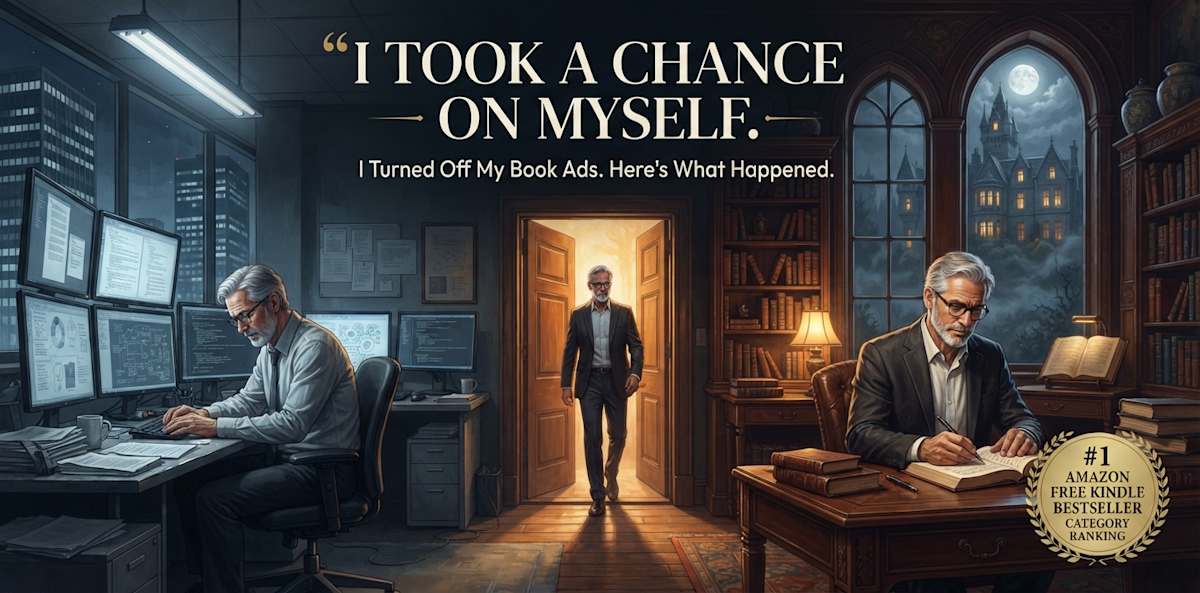
After three mental health crises, a career in corporate IT, and years of dreaming about writing full-time, I made the most frightening decision of my life. Then I switched off my paid advertising and waited to see whether my books could survive without it.
By Iwan Ross | 19 November 2026
There comes a moment in life when you realise that the greatest risk isn't necessarily walking away from everything you've worked for.
Sometimes, the greatest risk is staying exactly where you are.
I know.
I've been there.
And this is the story of how I walked away from a successful career in corporate IT, switched off the paid advertising that had supported my books, and took the biggest chance of my life.
Not on a company.
Not on a client.
Not on another promising business opportunity.
On myself.
Once Upon a Time, I Had a Rather Interesting Life
Many years ago, I owned and operated my own IT company.
And what a life it was.
I travelled extensively, met fascinating people, and spent my days servicing computer systems, designing networks, and developing technical solutions for businesses.
Some of my clients were farmers exporting grapes and wine. I developed systems to help manage their waybills and business operations.
Others were rather wealthy individuals whose lives occasionally resembled something from a television soap opera.
I met famous rugby players.
I received marriage proposals from extraordinarily wealthy widows who lived in houses large enough to accommodate several extended families.
I somehow adopted two dogs who seemed to prefer me to their actual owners and would become terribly distressed whenever I left.
And then there were my coastal adventures.
I'd travel to picturesque seaside towns to visit clients, only to find myself being asked to help their mistresses with computer problems.
Naturally, I did my best to remain professional.
And, more importantly, out of their bedrooms.
HAHA!
Looking back, I sometimes wonder whether I should have written a comedy instead of Gothic ghost mysteries.
But beneath all that excitement, there was another part of my life.
I loved reading.
And I loved writing.
I wrote short stories whenever I could, and I dreamed of the day when I might finally sit down and write novels.
Not between appointments.
Not after another exhausting day.
But properly.
As a writer.
Unfortunately, life doesn't always cooperate with our dreams.
When Life Forced My Hand
Eventually, circumstances changed.
I found myself facing one of the most difficult decisions of my life.
I could fight to rebuild my financial security, or I could allow everything to collapse around me.
I chose to fight.
And that meant returning to something I had hoped to leave behind.
Corporate IT.
My first position was as an Implementations Analyst and Engineer, designing technical specifications for client applications and websites integrating with a software-as-a-service platform.
The work was demanding.
There were endless meetings, complicated integrations, and hours spent coordinating with technical teams to ensure that every detail was correct.
I worked on projects involving internationally recognised brands, including ASOS, Sage, Microsoft, Apple, and LightInTheBox.
Professionally, it was challenging and rewarding.
Personally, it came at a terrible cost.
The pressure became overwhelming.
Eventually, my mental health deteriorated to the point where I required treatment in a mental health clinic.
That was my first warning.
But I still had responsibilities.
Bills to pay.
Debts to settle.
A life to rebuild.
So I tried again.
Three Jobs. Three Crises.
My next position was as a Solutions Engineer at a South African company.
This time, I worked with payment gateway integrations for clients and merchants across Africa.
The technical challenges were fascinating, particularly because payment systems in many African markets operate differently from those in Europe and America.
But the pressure returned.
And once again, I ended up receiving treatment in a mental health clinic.
Strike two.
I recovered, gathered myself, and continued searching for a role that might finally offer the right balance.
Then I landed the position I'd dreamed of for years.
Lead Technical Writer.
I was responsible for documentation across five platforms operating in four international markets.
Finally, I was doing something that combined my technical knowledge with my love of writing.
Surely this would be different?
Unfortunately, the demands were relentless.
And eventually, my mental health suffered another serious setback.
Strike three.
Another stay in a mental health clinic.
But this time, something inside me had changed.
I was no longer merely someone who dreamed about becoming an author.
I had already published books.
I had readers.
I had characters who occupied my thoughts long after I'd closed my laptop.
And I knew, with increasing certainty, that I wanted to write full-time.
The problem was finding a way to make that possible.
One Final Promise
My clinical psychiatrist strongly discouraged me from returning to the same pressures.
Other people were concerned, too.
My wife was the exception.
Well, perhaps she was particularly fond of my salary.
HAHA!
But I had made myself a promise.
I would return to work long enough to pay off every debt I owed.
Then I would decide what came next.
So I went back.
I worked.
I endured the pressure.
And I continued writing whenever I could.
I also had a professional commitment to fulfil.
The company's documentation was spread across multiple platforms, and I had undertaken to bring it all together into a unified documentation environment.
I wanted to finish what I'd started.
And I did.
Eventually, the final debt was paid.
My professional commitments had been fulfilled.
And suddenly, the decision I'd been postponing was staring me in the face.
Stay in a well-paid job that was taking an enormous toll on me?
Or walk away and try to make a living doing what I loved?
I was frightened.
Of course I was.
But when my wife asked why I wanted to take such a risk, I told her something that had been troubling me for years.
I didn't want to look back ten years later and ask myself, "What if?"
What if I'd tried?
What if I'd believed in myself?
What if I'd given my books the time and attention they deserved?
I couldn't bear the thought of spending the rest of my life wondering.
So I resigned.
The Strange Silence of Payday
Leaving corporate employment was liberating.
It was also terrifying.
For years, payday had been a reassuring fixture in my life.
Money arrived in my bank account.
Bills were paid.
The following month, the process repeated itself.
Then suddenly, payday came and went.
And nothing happened.
I would instinctively check my phone.
No salary notification.
No reassuring deposit.
Just the uncomfortable realisation that I had voluntarily walked away from something most people would consider financial security.
I had chosen uncertainty.
And I was determined to make it work.
But there was one enormous problem.
My book advertising.
The Advertising Trap
While I was employed full-time, my book marketing strategy relied heavily on paid social media advertising.
It worked.
My books reached readers.
My titles maintained visibility.
And I could afford to keep the campaigns running because I had a regular salary.
But without that salary, the situation changed dramatically.
Every advertising deduction became a reminder that my savings weren't unlimited.
I began dreading those notifications.
Sometimes, I simply closed my eyes when another payment appeared.
Not the most sophisticated financial strategy, I'll admit.
But I knew something had to change.
I couldn't continue spending money indefinitely in the hope that paid advertising would sustain my books.
I needed another way.
And somewhere in the middle of all that anxiety, I noticed something interesting.
A tiny opportunity.
Almost insignificant.
Something I'd overlooked because I had been concentrating so heavily on paid promotion.
Organic discovery.
A Different Kind of Book Marketing
What if I could build a system that introduced readers to my books without constantly paying social media platforms to display advertisements?
What if readers could discover my stories while searching for the kinds of books they already loved?
Scottish Gothic ghost mysteries.
Haunted manor stories.
Supernatural suspense.
Historical ghost mysteries.
And what if one book could introduce readers to an entire fictional world?
I already had the perfect candidate.
The first novel in my Haunted Highlands series.
And, importantly, a book I could offer free across major ebook retailers.
I began developing a new approach.
Instead of concentrating almost entirely on paid advertisements, I invested my time in editorial articles, search-friendly book features, reader-focused descriptions, Pinterest discovery, and content designed to help people find my stories organically.
Each book became part of a larger discovery system.
And Elm Brook Manor became the entrance.
A free invitation into Coby McTavish's haunted world.
From there, interested readers could discover the other novels.
It was a funnel, certainly.
But unlike my advertising campaigns, it didn't require me to pay every time someone encountered my work.
I worked on it relentlessly.
Planning.
Writing.
Publishing.
Refining.
And hoping.
Because I knew that if this approach failed, I would have some very difficult decisions to make.
Eventually, the day arrived.
I switched off my paid social media advertising.
Completely.
Then I Stopped Looking
You might imagine that I immediately began monitoring every sales dashboard, refreshing reports and studying the results.
Actually, I did almost the opposite.
I avoided them.
I was frightened of what I might discover.
What if sales collapsed?
What if the advertising had been responsible for nearly everything?
What if my carefully constructed strategy turned out to be little more than wishful thinking?
So I kept working.
And tried not to look.
Then my birthday arrived.
My wife noticed that I looked exhausted.
She pointed out the dark circles beneath my eyes and suggested I needed a break.
For once, I listened.
And I did something I hadn't allowed myself to do in years.
Absolutely nothing productive.
We lazed in the sunshine.
We splashed about in the swimming pool.
We watched entire Netflix series in broad daylight.
Imagine that!
A grown man watching television during working hours without feeling compelled to check his email every five minutes.
It was glorious.
For several days, I stopped worrying about deadlines, sales reports and marketing campaigns.
I simply enjoyed being alive.
But eventually, Monday arrived.
And reality came knocking.
The Monday That Changed Everything
I returned to my writing desk.
I had work to do.
My next novel, The Silent Choir, was due to launch the following day.
And I could no longer avoid my sales reports.
So I opened the dashboard.
And nearly fell off my chair.
My books had continued selling while I was on holiday.
Without paid social advertising.
Without constant promotional activity.
Without me sitting at my desk worrying about every little movement in the rankings.
Readers had continued discovering my stories.
I stared at the figures.
Then I checked Google Analytics.
There had been an initial drop in website traffic after I switched off the advertisements.
That was hardly surprising.
But then something encouraging happened.
Traffic began climbing again.
Steadily.
I checked my Draft2Digital reports.
Sales there were holding up, too.
Amazon was showing similar encouraging signs.
I couldn't believe it.
My books hadn't simply disappeared from view when I stopped paying for advertising.
The discovery system I'd been building appeared to be doing its job.
For the first time in months, I felt something I hadn't dared to feel.
Relief.
Perhaps, just perhaps, I had found a sustainable way forward.
Of course, that wasn't the end of the story.
Because life has a peculiar sense of humour.
And Amazon was about to provide an unexpected test.
Then Amazon Pulled the Rug Out From Under Me
The following morning, I noticed something alarming.
Sales and activity around Elm Brook Manor had weakened.
I investigated.
And discovered that Amazon had removed the book's free price.
For a long time, Elm Brook Manor had been available as a permanently free ebook.
It was the foundation of my reader-discovery strategy.
Now, without warning, Amazon had assigned it a price.
My free entry point was no longer free.
I contacted Kindle Direct Publishing support.
What followed was a lengthy conversation involving explanations, requests, and eventually an escalation.
I explained why the book should remain free.
I pointed out that it was available at no charge through other retailers.
And I pleaded my case.
Eventually, Amazon restored the free price.
But the interruption had already affected the book's visibility.
A title that had regularly performed strongly in its free Kindle categories had fallen dramatically.
At one point, its category ranking had slipped beyond #500.
I was devastated.
But then something remarkable happened.
From Beyond #500 to #18
Once Amazon restored the free price, Elm Brook Manor began climbing again.
And climbing.
And climbing.
Within approximately two days, it had recovered to:
#18 in Horror Suspense
#20 in Paranormal Ghost Romance
#24 in Ghost Suspense
These were Amazon's free Kindle category rankings, not overall paid-book rankings.
And I have the screenshots.
Just as I have screenshots of the website analytics and the sales reports that helped me understand what was happening.
Of course, rankings fluctuate, and a category position alone doesn't tell you how many books have been downloaded or how much revenue an author has earned.
But watching the book recover so quickly after its free price was restored was enormously encouraging.
It suggested that the free-book entry point remained an important part of my discovery strategy.
And, taken together with my other reports, it gave me something I'd desperately needed.
Evidence that my books could continue reaching readers without relying entirely on paid social media advertising.
I wasn't imagining everything.
Something was working.
What I Learned When I Stopped Paying for Attention
I want to be careful here.
I'm not suggesting that paid advertising is bad.
It helped me enormously when I was working full-time.
Nor am I suggesting that every author should resign from a secure job and hope for the best.
My circumstances were my own.
I had spent years building a catalogue of books.
I had made sacrifices.
I had paid off my debts.
I had developed a strategy and spent considerable time implementing it.
And even now, there are no guarantees.
Organic discovery takes work.
Search traffic changes.
Retailer algorithms change.
Readers' interests change.
And book sales can fluctuate from one day to the next.
But I learned something important.
Paid advertising is not the only way for readers to discover books.
And perhaps even more importantly, I learned that I didn't have to spend every waking hour promoting my stories to give them a chance of being found.
My books could continue working while I rested.
While I spent time with my wife.
While I enjoyed a birthday.
While I lived.
That, to me, was worth more than another impressive job title.
The Greatest Investment I Ever Made
When I think about my former career, I don't regret everything.
Far from it.
I learned extraordinary things.
I met fascinating people.
I solved complicated problems.
I worked with talented teams across international markets.
And I developed technical skills that I still use every day.
In fact, those skills helped me build the very strategy that now supports my writing.
But I also learned that professional success means very little when the price becomes too high.
Three serious mental health crises taught me that lesson in a way I will never forget.
I don't regard leaving my job as a universal solution, or something that would necessarily be right for anyone else.
For me, it was a carefully considered decision made after years of struggle.
And it was frightening.
Sometimes, it still is.
There are days when I worry.
Days when sales disappoint.
Days when I wonder whether I've made a terrible mistake.
But then I remember the alternative.
Ten years from now, sitting somewhere with a comfortable salary and an impressive job title, wondering what might have happened if I'd dared to try.
And I know which uncertainty I would rather live with.
Because the greatest investment I ever made wasn't in a business, an advertising campaign, or a technical platform.
It was in myself.
Now, I Can Finally Say It
For years, I introduced myself through my profession.
IT consultant.
Implementations Engineer.
Solutions Engineer.
Lead Technical Writer.
I was proud of the work I did.
But somewhere inside me, another identity was waiting.
An identity that had been there since those afternoons spent reading books and dreaming about writing stories of my own.
An identity that survived corporate deadlines, financial uncertainty, and some of the darkest periods of my life.
An identity that refused to disappear.
Today, I still have bills to pay.
I still have challenges to overcome.
And I certainly haven't discovered some magical formula that guarantees success.
But I have something I once thought might remain forever out of reach.
The freedom to spend my days doing the work I love.
Writing stories.
Creating characters.
Building worlds.
And inviting readers into them.
I took a chance.
Not because I knew it would work.
But because I couldn't bear never finding out.
And after everything I've been through, everything I've learned, and everything I've risked, I can finally say something that means more to me than any job title I've ever held.
I am a writer.
Iwan Ross