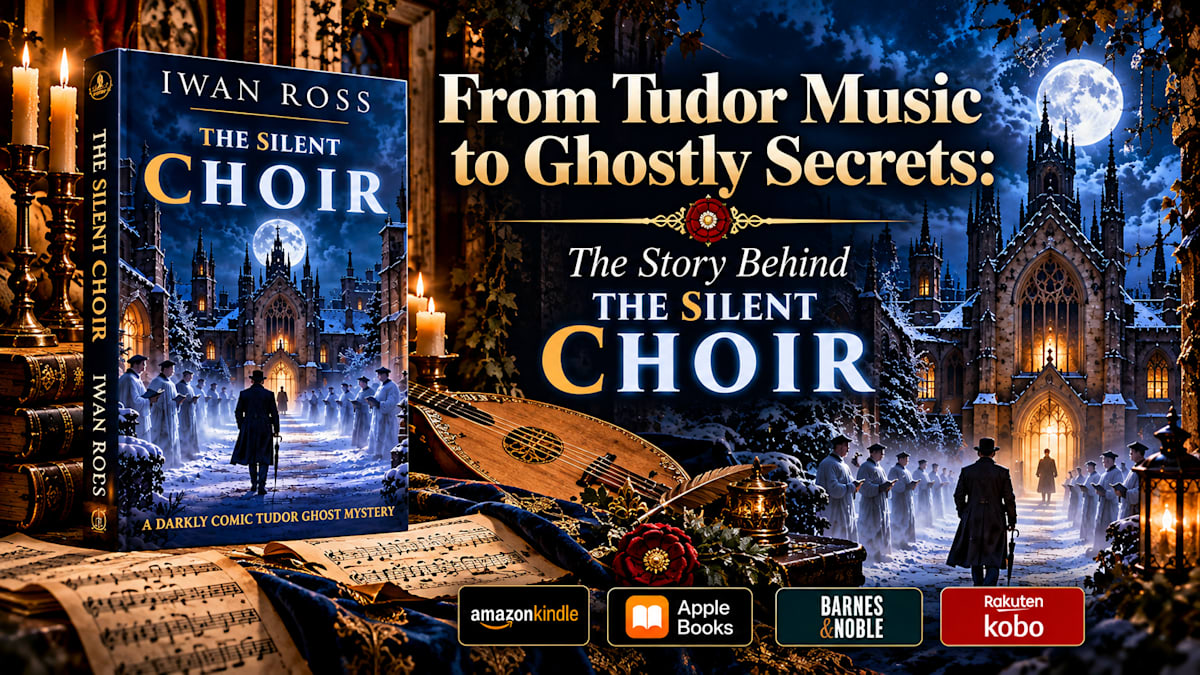
How a television series, two historical figures and a growing piece of writing software helped me discover the story I wanted to tell.
Sometimes the inspiration for a novel arrives when you least expect it.
A passing conversation. A forgotten photograph. A peculiar historical detail that refuses to leave your imagination alone.
In the case of The Silent Choir, it began with a television series.
At the time, we were watching The Tudors on Netflix.
Now, if there's one thing the Tudors have never lacked, it's drama.
Royal ambition, dangerous loyalties, forbidden romance, betrayal and enough political intrigue to keep a novelist occupied for years.
But somewhere among the magnificent costumes, troubled marriages and royal scandals, two names began to occupy my thoughts.
Anne Boleyn.
And Thomas Tallis.
I knew relatively little about either of them.
But I had a feeling there might be a story waiting somewhere between their worlds.
I simply needed to find it.
Two Names and One Very Difficult Question
When I began developing the second novel in The Highlands University of Ghostology series, I wanted to explore something beyond the familiar boundaries of a contemporary ghost mystery.
I wanted history to become part of the supernatural experience.
Not merely as background decoration, but as something that could influence the characters, deepen the mystery and give the story an emotional connection to the past.
Anne Boleyn was an intriguing figure.
A queen whose life and tragic downfall remain subjects of fascination centuries later.
Thomas Tallis was a different kind of historical personality.
A composer whose remarkable career belonged to the world of Tudor sacred music.
On the surface, they seemed to occupy different corners of history.
And that left me with a question.
How could I bring them together in a work of fiction without losing the historical atmosphere that made them so compelling?
I didn't have an answer.
Not yet.
Down the Tudor Research Rabbit Hole
There comes a moment in writing historical fiction when imagination has to make room for research.
And I soon discovered that I had rather a lot of research ahead of me.
I began exploring the lives of Anne Boleyn and Thomas Tallis, the musical traditions of Tudor England, the world of royal courts and the cultural importance of music and poetry.
One discovery led to another.
A historical detail suggested a new question.
A musical tradition opened another avenue of investigation.
And slowly, I began to recognise a connection I could use creatively.
Music and poetry.
There it was.
Not a claim that these two historical figures shared the personal relationship I might invent for a novel, but a fascinating artistic bridge between their worlds.
Music could carry memory.
Poetry could preserve emotion.
And a melody, perhaps, could outlive the people who first heard it.
For a supernatural novelist, that was an irresistible possibility.
What if something from the Tudor past had never truly been forgotten?
What if music could become part of a mystery that reached across centuries?
And what if the voices of the dead had something to tell us, provided someone knew how to listen?
At last, I could see the beginnings of a story.
When StoryLedger Became My Research Companion
There was another important part of this journey.
At the time, I had already made considerable progress developing StoryLedger, the desktop application I created to help fiction authors organise their stories.
One of its capabilities allowed me to connect research to characters, places and timelines.
And suddenly, that became extraordinarily useful.
Because researching a historical novel is one thing.
Keeping track of how everything fits together is quite another.
I had Tudor personalities to understand.
Historical locations to investigate.
Musical traditions to explore.
And a developing fictional plot that needed to weave all those elements together without losing its direction.
StoryLedger gave me a way to organise those discoveries and connect them to the fictional world I was building.
A piece of research could belong to a character.
A historical event could connect to a place.
A detail from the Tudor period could influence a contemporary storyline.
And as those connections grew, the shape of the novel began to emerge.
I wasn't simply collecting historical facts anymore.
I was discovering relationships between ideas.
And those relationships were helping me tell the story.
A Choir, a Mystery and a Cast of Tudors
Once I had found my creative connection through music and poetry, I could begin developing the plot in earnest.
The possibilities were wonderful.
Ancient music.
Supernatural events.
Hidden secrets.
Long-forgotten romance.
And an ensemble of Tudor characters whose lives could become entangled with the mysteries of The Highlands University of Ghostology.
I wanted the historical elements to feel meaningful.
I wanted the music to carry something more than a pleasant melody.
And I wanted the supernatural mystery to have an emotional heart.
Because behind every old secret, there may be a person who once loved, hoped, suffered or made a choice that changed everything.
History records the great events.
Fiction allows us to imagine the human stories that might exist between them.
That was the opportunity I saw in The Silent Choir.
And once I began bringing those elements together, the novel developed a life of its own.
Of course, Coby McTavish and the rather eccentric world of Ghostology would have their part to play.
I wasn't about to abandon the British dark humour that had become such an enjoyable feature of the series.
But beneath the comedy and supernatural intrigue, I wanted readers to discover something more.
A mystery rooted in history.
And perhaps a love story that time itself had failed to erase.
As for how those elements come together?
Well, that would be telling.
And I have absolutely no intention of spoiling the surprises.
The Novel That Helped Me Improve My Software
Something rather unexpected happened while I was developing the story.
The more I used StoryLedger to organise my research, characters, places and timelines, the more I began to see opportunities to improve the application itself.
I could identify relationships that deserved to be easier to follow.
Story threads that needed clearer connections.
And ways of helping an author understand how seemingly separate details might influence one another.
In other words, writing The Silent Choir wasn't simply giving me a practical use for StoryLedger.
It was helping me discover what StoryLedger needed to become.
As I worked on the novel, I continued developing features that made it easier to tie story threads together.
The writing informed the software.
And the software helped me manage the writing.
It became a wonderfully productive relationship.
There's something deeply satisfying about developing a tool and then putting it through its paces on a real creative project.
You discover things that might never occur to you while simply planning features on paper.
You encounter the small frustrations.
You notice the missing connections.
And sometimes, you realise that a particular improvement could make a meaningful difference to other writers, too.
That experience has continued to influence StoryLedger's development.
In fact, I'm now getting close to introducing another feature that I believe authors will find particularly useful.
I'm keeping the details under wraps for the moment.
But I can say that the lessons learned while developing The Silent Choir have helped shape the way I think about organising complex fiction.
Two Creative Journeys, One Story
Looking back, I find it rather remarkable how everything came together.
A television series introduced me to historical personalities I wanted to understand better.
Research led me towards music and poetry.
Those discoveries helped me develop a supernatural mystery involving Tudor history, forgotten secrets and romance.
And the process of organising it all helped me improve the very software I had created for writers.
Two creative projects were developing alongside one another.
One was a novel.
The other was an application designed to help authors manage novels.
And each was making the other better.
I hadn't planned it that way.
But some of the most rewarding creative discoveries are the ones you never anticipated.
The Voices That Refuse to Be Forgotten
There is something haunting about ancient music.
A composition can survive long after its creator has died.
A melody can be performed centuries after the world in which it was written has disappeared.
And a few notes can evoke emotions that seem remarkably unchanged by the passage of time.
Love.
Grief.
Longing.
Hope.
Perhaps that's what drew me most strongly towards the story that became The Silent Choir.
The thought that some things endure.
That the past can still speak to us.
And that even when the voices themselves have fallen silent, their stories may not be finished.
I began with two names and a question.
I found music, poetry, history and the beginnings of a supernatural mystery.
And somewhere along the way, I discovered another reason to keep developing StoryLedger.
That's the story behind The Silent Choir.
The rest?
Well, you'll have to read the novel.
Because some secrets are much too good to give away.
Discover The Silent Choir
Book Two in The Highlands University of Ghostology series.
Explore the novel and find your preferred retailer:
https://iwanross.com/books/the-silent-choir
Explore the series:
https://iwanross.com/series/the-highlands-university-of-ghostology
Read the spoiler-free introduction to the novel:
https://iwanross.com/blog/love-supernatural-mysteries-with-british-humour-discover-the-silent-choir
Discover StoryLedger
The desktop application for fiction authors, developed alongside my own writing projects: