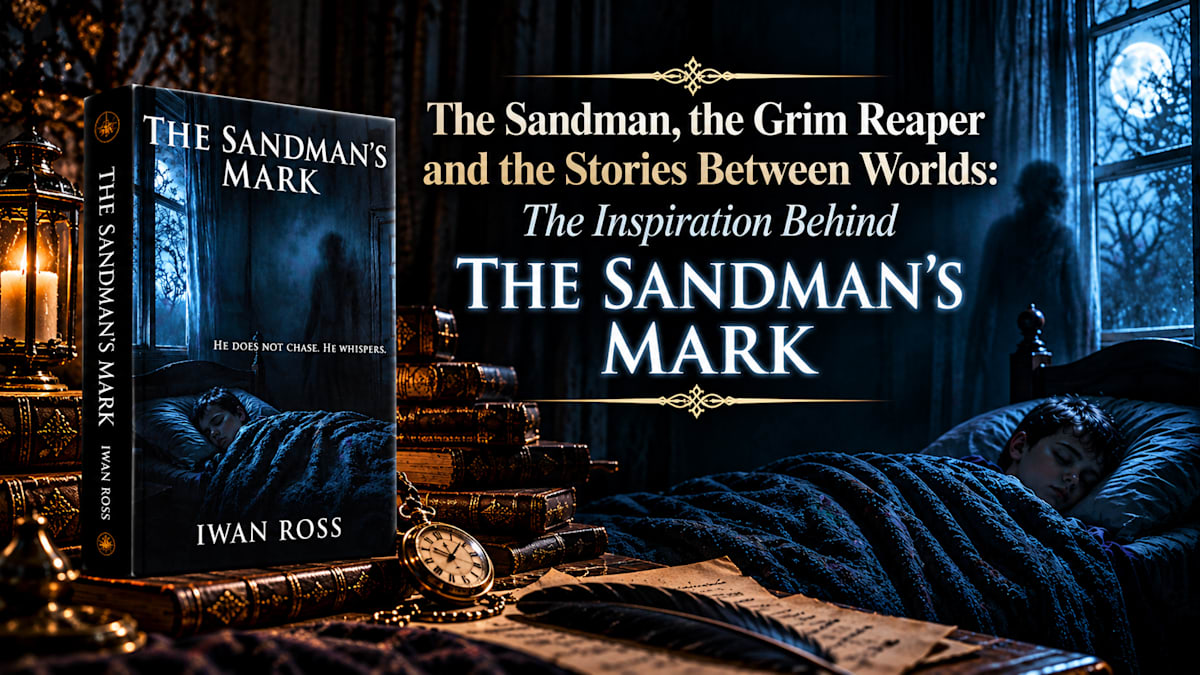
How a familiar figure from folklore became the bridge between supernatural horror, historical fiction and the Second World War.
Every story begins somewhere.
Sometimes, an idea arrives through a personal experience. Sometimes, a character appears unexpectedly and refuses to leave. And sometimes, all it takes is a simple question:
What if I could bring two very different kinds of storytelling together?
That was the question behind The Sandman's Mark.
I wanted to find a way to connect supernatural fiction with historical fiction, including events surrounding the Second World War. I enjoy exploring the past through storytelling, but I also love the freedom that supernatural elements provide.
The challenge was finding something that could bring those worlds together naturally.
And the answer, rather unexpectedly, was the Sandman.
Finding the Right Character
Most of us are familiar with the Sandman.
He's a figure associated with sleep and dreams, often appearing in childhood stories as a mysterious visitor who arrives when the world grows quiet.
But what makes the Sandman interesting to me is that people don't necessarily see him in the same way.
Some might regard him with affection.
Others might find him frightening, even loathsome.
And some might feel entirely indifferent towards him.
I liked that.
A character who inspires different reactions depending on who encounters him offers far more storytelling possibilities than one who is simply good or evil.
I wasn't looking for a conventional villain. I wanted a figure who could occupy that uncertain space between the familiar and the frightening.
Someone whose presence might mean different things to different people.
The Sandman gave me exactly that.
A Familiar Approach with a Different Figure
In Hemlock Manor, I explored a similar idea by bringing the Grim Reaper into the story.
The Grim Reaper is another figure almost everyone recognises, yet our reactions to him can be complicated.
He represents death, something people naturally fear, but fiction allows us to examine such figures from perspectives that aren't always straightforward.
For The Sandman's Mark, I wanted to take that creative approach in a different direction.
Rather than the Grim Reaper, I chose the Sandman.
Both figures belong to the wider world of folklore and the supernatural, but they evoke very different associations.
One is linked to death.
The other to sleep and dreams.
And dreams, of course, provide a fascinating territory for a storyteller.
They can be comforting, unsettling, beautiful or terrifying.
They can take us somewhere we have never been.
And in fiction, they can become doorways to things we might otherwise struggle to explain.
Bringing the Supernatural into History
The other important part of my idea was history.
I've always enjoyed the possibilities that arise when a fictional story reaches into another time.
Historical settings offer their own atmosphere, conflicts and mysteries. The Second World War, in particular, provides a backdrop shaped by extraordinary human experiences.
But I didn't want the supernatural elements to feel as though they had simply been added to a historical story for effect.
I wanted a connection.
Something that could allow the two genres to belong in the same fictional world.
The Sandman became that connection.
Once I had chosen him, I had a character through whom I could explore the relationship between supernatural events and historical storytelling.
It gave me the creative freedom to move between different kinds of mystery without treating them as entirely separate worlds.
That was the key I had been looking for.
Not Everyone Has to Love the Sandman
One of the things I enjoy most about writing fictional characters is that readers don't have to agree about them.
A character can be fascinating without being likeable.
They can be unsettling without being entirely evil.
And they can inspire sympathy in one reader while leaving another deeply uncomfortable.
That's how I think about the Sandman.
Some readers may loathe him.
Others may love him.
And others may remain neutral.
I'm perfectly happy with that.
In fact, I rather like the idea that readers might finish the novel with different opinions about the same character.
Stories become more interesting when they leave room for interpretation.
The Idea Behind The Sandman's Mark
And that, really, is the story behind The Sandman's Mark.
There wasn't a grand revelation or an extraordinary event that inspired it.
I simply wanted to connect supernatural fiction with historical fiction, including the Second World War, and I found the answer in a familiar but wonderfully ambiguous figure.
The Sandman.
Much as the Grim Reaper helped me explore certain ideas in Hemlock Manor, the Sandman offered a different way to approach the supernatural.
Sometimes, that's all a story needs.
One character.
One idea.
And the freedom to discover where they might lead.
If you enjoy supernatural horror, historical mysteries, haunted houses and stories that blur the boundaries between the ordinary and the unexplained, I invite you to discover The Sandman's Mark.
https://iwanross.com/books/the-sandman-s-mark
After all, whether you love him, loathe him or simply don't know what to make of him, the Sandman has a story to tell.